

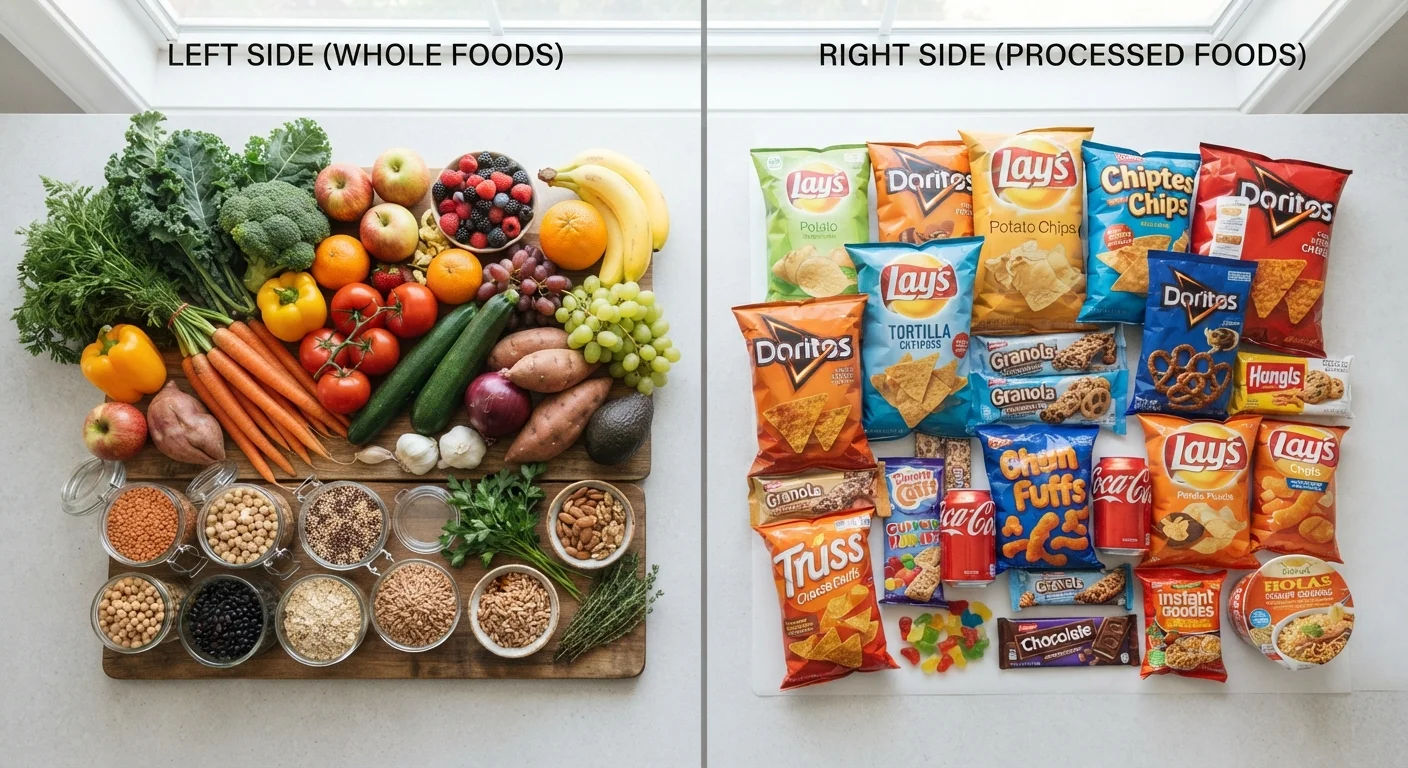
Key Takeaways
- Whole foods retain their natural fiber, vitamins, and phytonutrients with little or no industrial alteration.
- Ultra-processed foods are defined by industrial formulation — not just ingredient lists — using additives rarely found in home kitchens.
- Observational research consistently links high ultra-processed food intake to increased risk of chronic disease.
- Processing exists on a spectrum; not every packaged or convenience food qualifies as ultra-processed.
- Practical dietary improvement doesn't require perfection — shifting the balance toward whole foods matters most.
Option A
Whole Foods
The minimally processed, nutrient-dense baseline.
Best for: People seeking maximum nutritional value, fiber, and micronutrients from their daily diet.
Option B
Ultra-Processed Foods
The convenient, heavily engineered modern staple.
Best for: Understanding as a dietary pattern category rather than an occasional indulgence to eliminate entirely.
If you want to maximize daily nutrient density
Whole Foods
Whole foods deliver fiber, micronutrients, and beneficial plant compounds that are largely lost or absent in heavily processed alternatives.
If you're evaluating your overall dietary pattern rather than single meals
Whole Foods
Research suggests it's the consistent proportion of whole versus ultra-processed foods across the diet that drives health outcomes, not individual choices.
If convenience and cost are practical barriers
Whole Foods
Minimally processed options like canned legumes, frozen vegetables, and rolled oats offer whole-food nutrition with comparable convenience and affordability.
If you're trying to understand food labels and marketing claims
Whole Foods
Whole foods require little label scrutiny; learning to identify ultra-processed products by their ingredient lists is a more reliable guide than front-of-pack claims.
Defining the Terms: What Each Category Actually Means
Before comparing outcomes, it helps to understand what these terms mean in practice. Whole foods are foods that remain close to their natural state — think fresh or frozen vegetables, fruits, legumes, whole grains, eggs, plain dairy, and minimally processed meats. They may be cooked or combined but are not industrially reformulated.
Ultra-processed foods are defined by the NOVA classification system — a widely used research framework — as industrial formulations that go well beyond basic food processing. They typically contain ingredients such as hydrogenated oils, modified starches, protein isolates, artificial flavors, colorings, and emulsifiers not commonly used in home cooking. Packaged snacks, carbonated soft drinks, flavored instant noodles, reconstituted meat products, and many breakfast cereals often fall into this category.
It's important to note that processing itself is not the enemy. Minimally processed foods (like pasteurized milk or frozen peas) and processed culinary ingredients (like olive oil or flour) are distinct categories in NOVA and are not the focus of concern. The distinction matters because lumping all packaged foods together leads to confusion. See how this plays out with grains in our companion piece on whole grains vs refined grains.
| Criterion | Whole Foods | Ultra-Processed Foods |
|---|---|---|
| Processing level | Minimal — close to natural state | Heavy industrial formulation |
| Fiber content | Naturally intact and varied | Often removed or degraded |
| Additives | Few or none | Emulsifiers, preservatives, artificial flavors common |
| Micronutrient density | Generally high relative to calories | Often low; some are fortified artificially |
| Palatability engineering | Natural flavor profile | Optimized salt/sugar/fat combinations |
| Research association | Linked to lower chronic disease risk | Linked to higher chronic disease risk in large cohorts |
| Convenience | Variable; some require preparation | High — shelf-stable, ready-to-eat |
| Cost | Varies; staples can be affordable | Often low per calorie, higher per nutrient |
What the Research Actually Shows
The evidence linking ultra-processed food consumption to health outcomes has grown substantially over the past decade, though most of it comes from observational studies — meaning causation cannot be definitively established.
Large prospective cohort studies, including research published in journals such as The BMJ and JAMA Internal Medicine, have associated higher ultra-processed food intake with increased risks of cardiovascular disease, type 2 diabetes, obesity, and all-cause mortality. A notable randomized controlled trial published in Cell Metabolism (Hall et al., 2019) found that participants assigned to an ultra-processed diet consumed significantly more calories and gained more weight over two weeks compared to those eating an unprocessed diet — even when both diets were matched for total sugar, fat, fiber, and macronutrients.
Whole food dietary patterns, by contrast, are consistently associated with lower inflammatory markers, better gut microbiome diversity, and more favorable metabolic profiles. Much of this is attributed to fiber, polyphenols, and the complex food matrix — the physical structure of whole foods that affects how nutrients are absorbed and processed by the body.
~58%
Share of US adult calories from ultra-processed foods
Research published in BMJ Open (Martínez Steele et al.) estimated that ultra-processed foods account for roughly 58% of total energy intake among US adults.
+500 kcal/day
Extra calories consumed on ultra-processed diet
In the Hall et al. 2019 randomized controlled trial (Cell Metabolism), participants on an ultra-processed diet spontaneously ate about 500 more calories per day than those on an unprocessed diet.
10% increase
Ultra-processed intake linked to cardiovascular risk
A large French NutriNet-Santé cohort study found each 10-percentage-point increase in ultra-processed food consumption was associated with a roughly 12% higher risk of cardiovascular disease.
That said, researchers acknowledge that socioeconomic factors, stress, sleep, and physical activity are intertwined with dietary patterns, making it difficult to isolate food processing as the sole driver of outcomes. This is an active area of research, and findings should be understood as strong associations, not settled causal proof.
The Nutritional Gap: Why Structure Matters
Whole foods and ultra-processed foods differ not just in what they contain, but in how their nutrients behave. Fiber is a useful example: an apple and an apple-flavored snack bar may contain similar carbohydrate counts, but only the apple delivers intact pectin and cell-wall structures that slow glucose absorption and feed beneficial gut bacteria.
Ultra-processed foods are also often engineered for what researchers call hyper-palatability — combinations of salt, sugar, and fat calibrated to drive overconsumption. This can make portion regulation more difficult, regardless of individual willpower.
The Food Matrix: More Than the Sum of Its Nutrients
Nutrition science increasingly recognizes that how nutrients are packaged within a food affects how the body processes them — a concept called the 'food matrix.' Whole almonds, for instance, release fewer calories than almond butter because intact cell walls slow fat absorption. This means two foods with identical nutrition labels can behave very differently inside the body, and it's part of why whole food forms often outperform their processed equivalents even when calories match.
Whole foods aren't nutritionally perfect in isolation — some are high in saturated fat, sugar, or calories. But the overall dietary pattern they form when eaten regularly supports the range of nutrients the body needs. Labels on whole foods are rarely needed; labels on ultra-processed products can be misleading, as covered in detail in our article on nutrition label myths.
Practical Steps: Shifting the Balance Without Overhauling Your Life
Dietary change is most sustainable when it's gradual and realistic. A few evidence-informed approaches:
- Anchor meals around whole food ingredients. Building half your plate from vegetables, legumes, or whole grains before adding other components naturally reduces the proportion of ultra-processed items consumed.
- Use convenient whole food options. Canned beans, frozen vegetables, plain oats, and hard-boiled eggs all qualify as minimally processed and require minimal preparation.
- Read ingredient lists, not just nutrition panels. A long list of unfamiliar additives is a practical indicator of ultra-processing, regardless of calorie or fat counts.
- Apply the 80/20 principle. Most nutrition researchers emphasize dietary patterns over time rather than perfection at every meal. Occasional ultra-processed foods in an otherwise whole-food diet are unlikely to drive significant risk.
For a broader framework on structuring daily meals, our guide on building a balanced plate offers practical, evidence-informed principles. And if you want to interrogate common food beliefs further, nutrition myths examined is a useful companion read.
This article is for general informational and educational purposes only and is not a substitute for professional medical or dietary advice. Always consult a qualified healthcare provider or registered dietitian for guidance tailored to your individual health needs.