

Key Takeaways
- Envelope budgeting assigns every spending category a fixed dollar limit before the month begins.
- Digital versions replace physical cash with virtual category limits tracked by apps or spreadsheets.
- The method works best for variable spending categories like groceries, dining, and entertainment.
- Its biggest weakness in a cashless world is the lack of automatic friction that physical cash creates.
- Several free apps replicate the envelope system digitally with minimal setup time.
Immediate visual feedback on remaining category funds
Seeing a low balance — or an empty envelope — before a purchase decision is made is more effective than reviewing statements after the fact. This real-time awareness is the system's most cited benefit.
Naturally limits overspending in variable categories
Discretionary categories like dining and entertainment are where most household budgets leak. Hard category caps prevent gradual creep without requiring willpower at every transaction.
Simple enough to start without financial expertise
There's no formula to learn and no complex software to configure. If you know your monthly take-home pay and your spending categories, you have everything you need to begin.
Works alongside almost any other budgeting method
Envelope limits can be layered onto a percentage-based framework or a zero-based budget. You're not locked into a single system — the category logic is compatible with most approaches.
Encourages intentional spending decisions
Checking a category balance before spending — even digitally — creates a brief pause that reduces impulse purchases. That small habit compounds meaningfully over a full month.
No automatic friction in a cashless environment
Physical cash creates a natural pause: you count it, you hand it over, you receive change. A digital category limit requires you to voluntarily check a balance before tapping your card — which most people don't do in the moment.
Manual tracking is time-consuming and easy to abandon
Digital envelope systems that don't sync automatically require logging every transaction by hand. Research on budgeting behavior consistently shows that high-maintenance systems get abandoned within the first few months.
Poorly suited for fixed or irregular expenses
Rent, loan payments, utility bills, and subscription charges don't fit neatly into envelope logic. Most households end up using the envelope method only for a subset of their spending, requiring a hybrid approach.
Category boundary disputes can undermine the system
Is a gas station snack 'groceries' or 'dining out'? Households with two spenders often disagree on how to categorize transactions, which can erode both the tracking accuracy and the motivation to continue.
Credit card rewards create a real conflict
Many households rely on credit cards for travel points or cash back. Using credit within an envelope system is workable — but only if balances are paid in full monthly, adding a layer of financial discipline the basic method doesn't address.
Our Verdict
Envelope budgeting is one of the most intuitive systems for controlling day-to-day variable spending. The cashless adaptation loses some of its natural friction but retains the core benefit: hard category limits that make overspending visible before it happens. It takes consistent manual effort to maintain the same discipline that physical cash enforces automatically.
Best suited for people who overspend in specific variable categories and want a straightforward, visual system they can start without advanced financial knowledge.
What Envelope Budgeting Actually Is
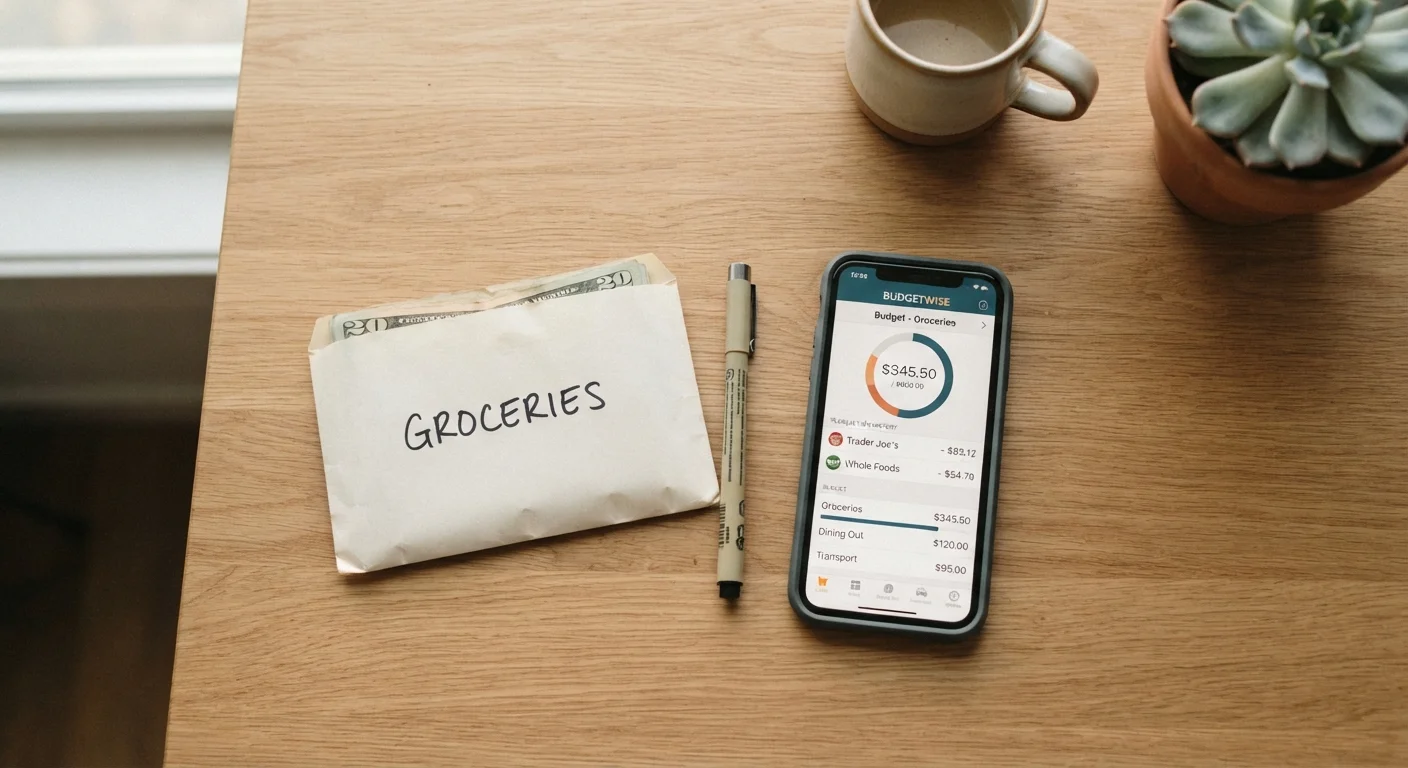
The envelope method is a straightforward cash-management system: at the start of each month, you divide your take-home pay into physical envelopes, each labeled for a spending category — groceries, gas, dining out, clothing, and so on. When an envelope is empty, spending in that category stops until the next month. No borrowing from other envelopes.
That hard stop is the whole point. Unlike a traditional budget you check after the fact, the envelope system gives you a real-time, physical signal: you can see and feel exactly how much remains. It was popularized by personal finance educators as a hands-on tool for people who struggle to connect abstract numbers on a spreadsheet to real spending decisions.
If you're newer to budgeting overall, it helps to have a solid monthly spending baseline before you assign envelope amounts. The first monthly budget guide walks through how to build that foundation.
Adapting the System for Digital Spending
Most household spending today flows through debit cards, credit cards, and digital wallets — not cash. That doesn't make the envelope concept obsolete, but it does require a workaround.
The two most common digital approaches are:
- Budgeting apps with category limits: Apps designed around envelope logic let you set a spending cap per category and manually log each transaction or sync with your bank. When a category hits its limit, the app flags it.
- Spreadsheet tracking: A simple monthly spreadsheet with category columns and a running total replicates the same logic manually. More effort, but no app required.
Neither approach fully replaces the tactile friction of handing over cash. You have to choose to check the app or update the spreadsheet — the system only works if you use it consistently. That self-imposed accountability is both the method's strength and its biggest challenge in a digital context.
Envelope Budgeting vs. Other Methods
Envelope budgeting is one of several structured approaches to managing monthly cash flow. It prioritizes simplicity and category awareness over comprehensiveness. If your financial situation involves variable income, significant debt repayment, or investment contributions, a more detailed framework may be worth exploring alongside it. This article covers general budgeting concepts and is not personalized financial advice — consider speaking with a nonprofit credit counselor or financial professional if you're navigating complex circumstances.
For a side-by-side look at how this approach compares with other budget frameworks, see zero-based vs. percentage-based budgeting.
Pros of the Envelope Method
The envelope system has lasted decades because its core mechanics genuinely help people rein in variable spending.
Immediate visual feedback on remaining category funds
Seeing a low balance — or an empty envelope — before a purchase decision is made is more effective than reviewing statements after the fact. This real-time awareness is the system's most cited benefit.
Naturally limits overspending in variable categories
Discretionary categories like dining and entertainment are where most household budgets leak. Hard category caps prevent gradual creep without requiring willpower at every transaction.
Simple enough to start without financial expertise
There's no formula to learn and no complex software to configure. If you know your monthly take-home pay and your spending categories, you have everything you need to begin.
Works alongside almost any other budgeting method
Envelope limits can be layered onto a percentage-based framework or a zero-based budget. You're not locked into a single system — the category logic is compatible with most approaches.
Encourages intentional spending decisions
Checking a category balance before spending — even digitally — creates a brief pause that reduces impulse purchases. That small habit compounds meaningfully over a full month.
It also pairs naturally with broader saving habits. Building category limits creates awareness of where discretionary money actually goes — a prerequisite for consistently setting money aside. The saving and emergency funds hub covers how to take that next step once your spending is under control.
Cons of the Envelope Method
The same simplicity that makes envelope budgeting appealing also creates real limitations, especially in a mostly cashless household.
No automatic friction in a cashless environment
Physical cash creates a natural pause: you count it, you hand it over, you receive change. A digital category limit requires you to voluntarily check a balance before tapping your card — which most people don't do in the moment.
Manual tracking is time-consuming and easy to abandon
Digital envelope systems that don't sync automatically require logging every transaction by hand. Research on budgeting behavior consistently shows that high-maintenance systems get abandoned within the first few months.
Poorly suited for fixed or irregular expenses
Rent, loan payments, utility bills, and subscription charges don't fit neatly into envelope logic. Most households end up using the envelope method only for a subset of their spending, requiring a hybrid approach.
Category boundary disputes can undermine the system
Is a gas station snack 'groceries' or 'dining out'? Households with two spenders often disagree on how to categorize transactions, which can erode both the tracking accuracy and the motivation to continue.
Credit card rewards create a real conflict
Many households rely on credit cards for travel points or cash back. Using credit within an envelope system is workable — but only if balances are paid in full monthly, adding a layer of financial discipline the basic method doesn't address.
~33%
US adults with a detailed monthly budget
Surveys by the National Foundation for Credit Counseling have consistently found that fewer than one in three US adults maintains a detailed monthly budget, suggesting tracking friction is a widespread barrier.
< 20%
US consumer payments made with cash
According to the Federal Reserve's Diary of Consumer Payment Choice, cash now accounts for less than 20% of US consumer transactions, down sharply from a decade ago.
For households with irregular income or complex financial lives, a more flexible framework may work better. The monthly budget setup checklist can help you figure out which method aligns with your actual situation before you commit to one approach.