

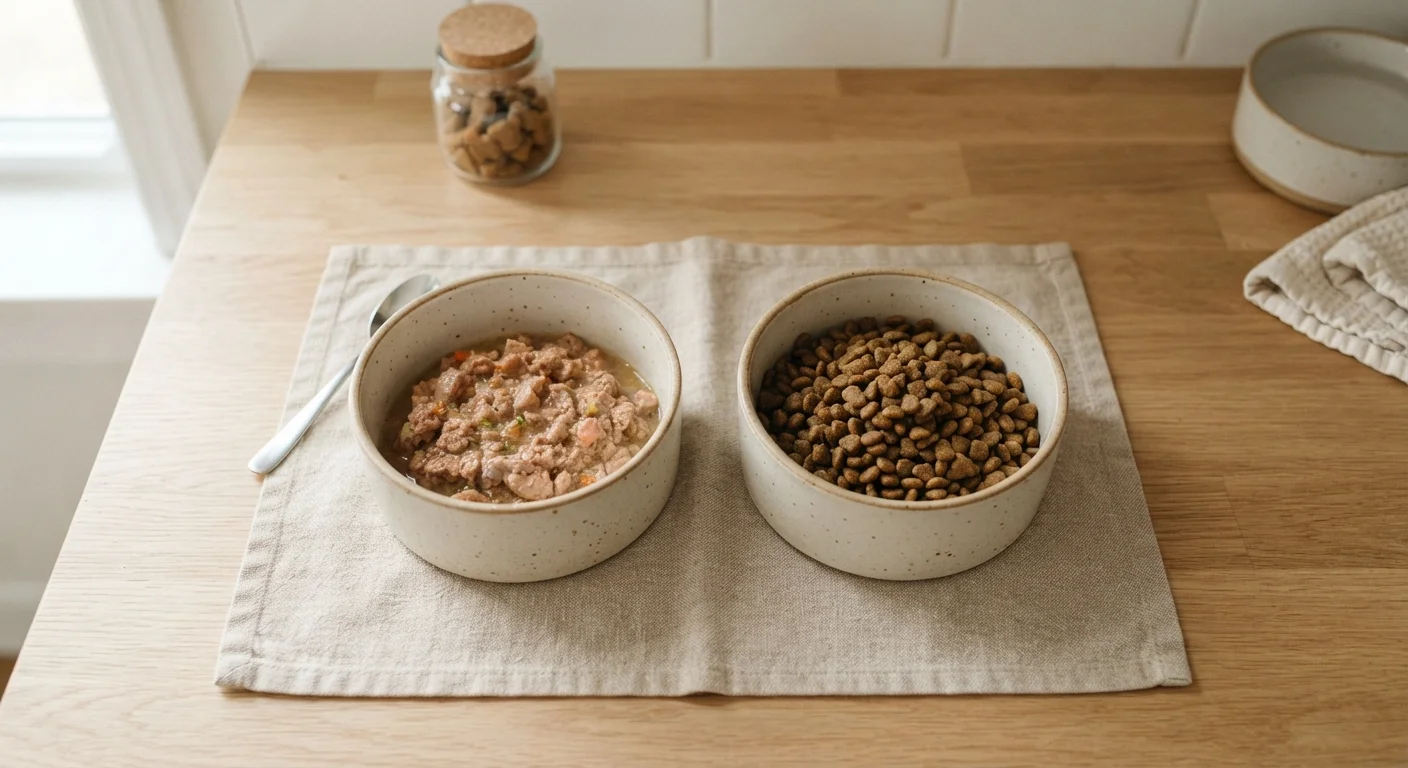
Key Takeaways
- Wet food contains roughly 70–80% water, making it a meaningful source of daily hydration for cats.
- Dry kibble is calorie-dense and convenient, but cats eating only dry food may chronically under-hydrate.
- Both formats can meet AAFCO nutritional standards — the label matters more than the format.
- Feeding both types together (mixed feeding) is a valid and commonly recommended approach.
- Cats with urinary tract conditions often benefit from the added moisture in wet food.
- Consult your veterinarian before making significant changes to your cat's diet.
Option A
Wet Cat Food
The moisture-rich, protein-forward option.
Best for: Cats prone to urinary issues, picky eaters, or those who need encouragement to stay hydrated.
Option B
Dry Cat Food (Kibble)
The convenient, calorie-dense everyday staple.
Best for: Multi-cat households, free-feeding setups, or owners managing tight feeding schedules.
If your cat has a history of urinary tract issues or kidney disease
Wet Cat Food
The high moisture content helps dilute urine and supports kidney function, which veterinarians commonly prioritize in cats with these conditions.
If convenience and cost-efficiency are your top priorities
Dry Cat Food (Kibble)
Kibble stores easily, doesn't spoil quickly at room temperature, and works well in timed or free-feeding dispensers.
If your cat is a finicky eater or has lost interest in food
Wet Cat Food
The stronger aroma and softer texture of wet food tend to be more appealing to cats with selective appetites or dental sensitivity.
If you want to balance nutrition, hydration, and practicality
Wet Cat Food
A mixed-feeding approach — wet food once or twice daily with dry food available — addresses hydration needs while retaining some convenience.
If you have multiple cats with different schedules
Dry Cat Food (Kibble)
Dry food doesn't need refrigeration after serving and can sit out longer without spoiling, making it easier to manage in busy households.
What Actually Separates Wet and Dry Cat Food
The most fundamental difference between wet and dry cat food isn't flavor or brand — it's water content. Wet food typically contains 70–80% moisture, closely mirroring the water content of prey animals. Dry kibble, by contrast, contains only about 10% moisture. That gap has real consequences for your cat's health, particularly because cats have a naturally low thirst drive — a trait inherited from desert-dwelling ancestors who obtained most of their hydration from food.
Beyond moisture, the two formats also differ in calorie density, ingredient composition, and texture. Dry food packs more calories per gram, which means portion control matters more. Wet food tends to have a higher proportion of animal protein and fewer carbohydrates, though formulations vary widely. For a deeper look at what cats truly require nutritionally, see what cats actually need from their diet.
| Criterion | Wet Cat Food | Dry Cat Food (Kibble) |
|---|---|---|
| Moisture content | 70–80% | ~10% |
| Calorie density | Lower per gram | Higher per gram |
| Typical protein source | Animal-forward, fewer fillers | Varies; may include more grains |
| Shelf life (opened) | 1–2 days refrigerated | Weeks to months, sealed |
| Cost per serving | Generally higher | Generally lower |
| Urinary health support | Strong — dilutes urine | Weaker without added water |
| Palatability for picky cats | High — strong aroma | Moderate — varies by formulation |
| Suitable for free-feeding | No — spoils quickly | Yes — stable at room temperature |
Hydration, Urinary Health, and Why Moisture Matters
Cats who eat primarily dry food often produce more concentrated urine than those eating wet food — and over time, this can increase the risk of urinary crystals, blockages, and kidney strain. This isn't a guaranteed outcome, but it's a pattern veterinarians frequently observe, particularly in male cats who are anatomically more prone to urinary obstructions.
Wet food's high moisture content acts as passive hydration — your cat consumes water simply by eating. Cats drinking from a bowl alone rarely compensate fully for the moisture gap in a dry-only diet, even with a running water fountain available. If your cat has been diagnosed with a urinary tract condition or early kidney disease, your veterinarian may specifically recommend increasing wet food intake or transitioning away from dry food.
~70%
Water content in typical prey animals
Feline nutritionists note that a cat's ancestral diet was roughly 70% water, which wet food more closely approximates than dry kibble.
10%
Moisture in dry kibble
Standard dry cat food contains approximately 10% moisture, a fraction of what cats historically obtained through food consumption.
3x
More concentrated urine in dry-fed cats
Research in feline nutrition suggests cats fed exclusively dry food tend to produce significantly more concentrated urine than those on wet diets.
Nutrition Labels: What to Look for Regardless of Format
Both wet and dry cat foods can meet the nutritional standards established by the Association of American Feed Control Officials (AAFCO), which sets minimum requirements for protein, fat, vitamins, and minerals. A food labeled "complete and balanced" for the appropriate life stage (kitten, adult, or senior) meets those minimums — the format alone doesn't determine nutritional adequacy.
When comparing labels, keep the moisture difference in mind. Dry matter basis comparison — which strips out water content before comparing nutrients — is the fairest way to evaluate two foods side by side. A wet food that looks lower in protein on the label often matches or exceeds dry food once moisture is factored out. Your veterinarian or a veterinary nutritionist can walk you through this if you're unsure.
Understanding 'Dry Matter Basis' Comparisons
Because wet and dry food have such different moisture levels, comparing nutrient percentages straight from the label can be misleading. Dry matter basis analysis removes water from the equation so you're comparing like for like. Many pet food manufacturers publish dry matter data on their websites, or your veterinarian can help you calculate it. This is especially useful when evaluating protein and fat content across food types.
Mixed Feeding: Is Offering Both a Good Idea?
Many veterinarians and feline nutritionists recommend a mixed feeding approach — typically wet food once or twice a day alongside measured dry kibble. This strategy helps address hydration without completely eliminating the convenience of kibble. It also introduces texture variety, which can reduce the risk of a cat becoming fixated on a single food type (a common problem that makes dietary changes harder later in life).
The key is calorie management. Both portions need to account for your cat's total daily caloric needs, which are influenced by age, weight, activity level, and whether they're spayed or neutered. Overfeeding even healthy food leads to weight gain — a serious concern given how commonly cats develop obesity-related conditions like diabetes and joint disease. Lifestyle factors also matter: indoor vs. outdoor living affects how many calories a cat actually burns each day.
This article is for general informational purposes only and is not a substitute for personalized veterinary advice. Always consult your veterinarian before making significant changes to your cat's diet, especially if your cat has an existing health condition.