

Why Water Chemistry Matters More Than Most New Owners Realize
Fish don't just live in water — they're constantly absorbing it through their skin and gills. When water chemistry is off, even slightly, it stresses the immune system, disrupts organ function, and makes fish vulnerable to disease. The troubling part: bad water often looks perfectly clear. You can't see ammonia or detect a pH crash with the naked eye.
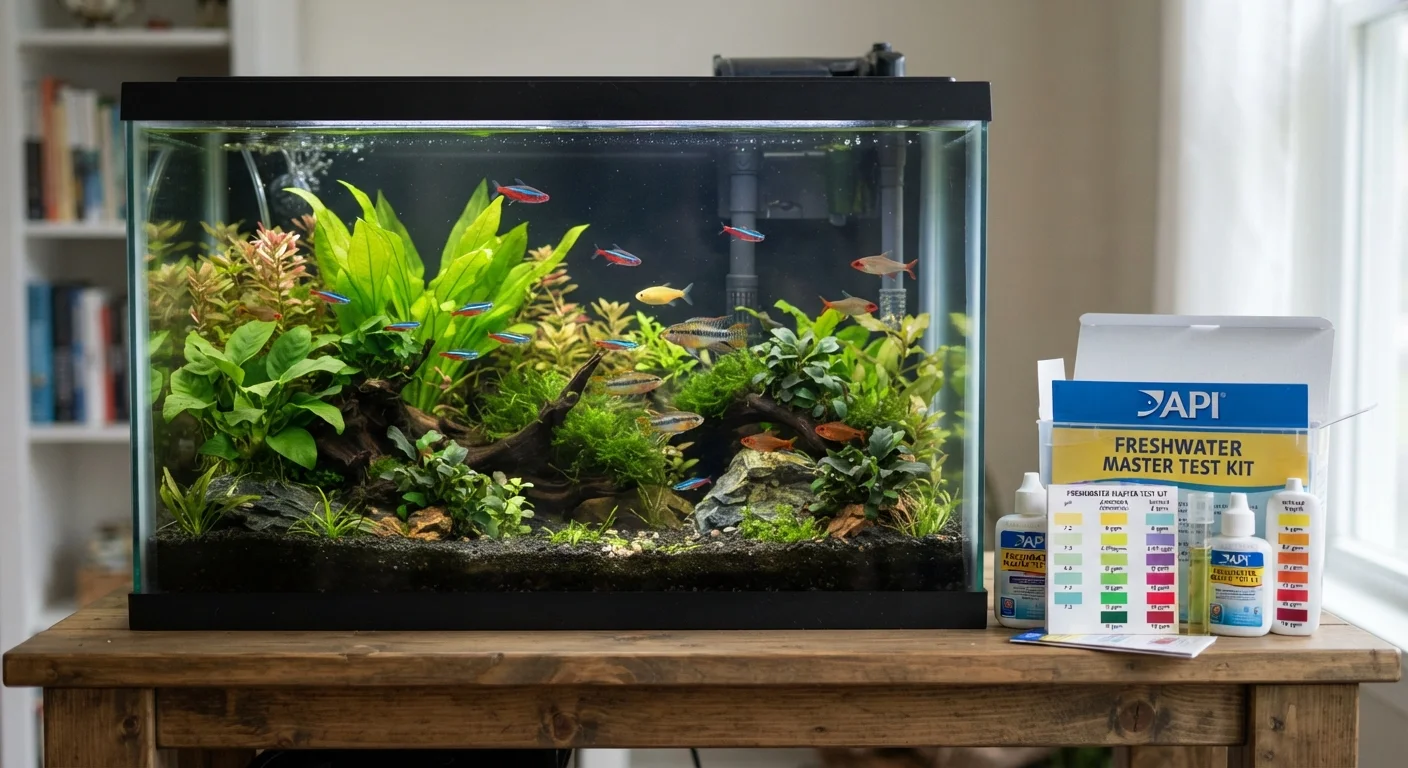
The good news is that monitoring water chemistry doesn't require a chemistry degree. A basic liquid test kit measures the four most critical parameters — pH, ammonia, nitrite, and nitrate — and gives you actionable readings in minutes. Understanding what those numbers mean is what this guide is for.
The Four Core Parameters Explained
pH
pH measures how acidic or alkaline your water is on a scale of 0–14, with 7.0 being neutral. Most common freshwater tropical fish thrive between 6.5 and 7.5. Sudden swings — even within that range — are more harmful than a stable reading slightly outside it. Test pH weekly and after any water change.
Ammonia (NH₃/NH₄⁺)
Ammonia is produced by fish waste, uneaten food, and decaying plant matter. It is toxic at any detectable level. The target is always 0 ppm (parts per million). Even 0.25 ppm stresses fish and damages gill tissue over time. Ammonia spikes most often in new tanks that haven't completed the nitrogen cycle.
Nitrite (NO₂⁻)
Beneficial bacteria in your filter convert ammonia into nitrite — but nitrite is also toxic. It interferes with blood oxygen transport. Like ammonia, the safe level is 0 ppm. Elevated nitrite is a sign your tank's biological filter isn't fully established or has been disrupted.
Nitrate (NO₃⁻)
The final product of the nitrogen cycle, nitrate is far less immediately toxic than ammonia or nitrite. Most freshwater fish tolerate levels up to 20–40 ppm, though lower is always better. Nitrate accumulates over time and is primarily controlled through regular partial water changes — typically 10–25% weekly.
Nitrogen Cycle
The biological process by which beneficial bacteria convert toxic ammonia (from fish waste) first into nitrite, then into the less harmful nitrate. A fully cycled tank has stable ammonia and nitrite readings of 0 ppm.
pH
A measure of how acidic or alkaline water is, scored on a 0–14 scale. A pH of 7.0 is neutral; below 7.0 is acidic, above 7.0 is alkaline.
ppm (Parts Per Million)
The unit used to measure dissolved substances — like ammonia or nitrate — in aquarium water. Very small concentrations can still be biologically significant for fish.
KH (Carbonate Hardness)
A measure of the water's buffering capacity, or its ability to resist changes in pH. Low KH makes a tank susceptible to sudden, potentially fatal pH crashes.
GH (General Hardness)
A measure of the total dissolved minerals — primarily calcium and magnesium — in aquarium water. Different fish species have different GH preferences.
Biological Filtration
Filtration performed by colonies of beneficial bacteria that live in filter media and break down ammonia and nitrite. It is the most important type of filtration in any aquarium.
Secondary Parameters Worth Monitoring
Once you're comfortable with the big four, two additional parameters are worth understanding:
- Water hardness (GH/KH): General hardness (GH) measures dissolved minerals like calcium and magnesium. Carbonate hardness (KH) measures buffering capacity — essentially, how well your water resists pH swings. Low KH (below 4 dKH) puts tanks at risk of sudden pH crashes, which can be fatal to fish.
- Temperature: Not a chemical parameter, but closely tied to chemistry. Warmer water holds less dissolved oxygen and accelerates bacterial growth and chemical reactions. Most tropical freshwater fish prefer 74–80°F (23–27°C). A reliable thermometer is as essential as a test kit.
Liquid Test Kits vs. Test Strips
Liquid reagent test kits are generally considered more accurate than paper test strips, particularly for low-level readings like 0.25 ppm ammonia that strips may miss. Test strips are convenient for quick checks but are less reliable as a primary diagnostic tool. For troubleshooting health problems, a liquid kit gives you more confidence in your readings.
Testing these secondary parameters every two to four weeks — or when troubleshooting health issues — gives you a fuller picture of your tank's stability.
Building a Simple Testing Routine
Consistency matters more than frequency. A simple routine prevents problems before they become emergencies:
- New tank (first 4–6 weeks): Test ammonia and nitrite every 2–3 days while the nitrogen cycle completes. You'll see ammonia rise, then nitrite rise, then both fall to zero as the beneficial bacteria population establishes.
- Established tank: Test all four core parameters weekly. Log your results — even a simple notebook entry — so you can spot trends before they cause harm.
- After any disruption (new fish added, medication used, filter cleaned, power outage): test within 24–48 hours. These events can destabilize chemistry quickly.
0 ppm
Target ammonia & nitrite in established tanks
Any detectable ammonia or nitrite indicates an active threat to fish health and should be addressed immediately.
4–8 weeks
Typical time to complete a new tank's nitrogen cycle
The exact duration varies with tank size, stocking level, temperature, and whether a bacterial starter culture is used.
20–30%
Partial water change recommended when parameters spike
A partial change dilutes toxins quickly without removing the beneficial bacteria established in filter media.
If a reading is out of range, a partial water change (20–30%) is usually the safest first response while you investigate the cause. Avoid the temptation to use multiple chemical additives at once — they can interact unpredictably and make diagnosis harder.
This article provides general educational information about aquarium care and is not a substitute for guidance from an aquatic veterinarian or experienced fishkeeping professional, particularly when fish show signs of illness.