

Key Takeaways
- Your three mirrors cover different zones — none of them covers everything on their own.
- Blind spots are real gaps that mirrors cannot fully eliminate; a quick head check fills them.
- How you set your mirrors matters as much as how often you check them.
- Checking mirrors every 5–8 seconds is a widely taught defensive driving guideline.
- Mirror checks before braking, changing lanes, or merging reduce collision risk significantly.
Mirror Awareness
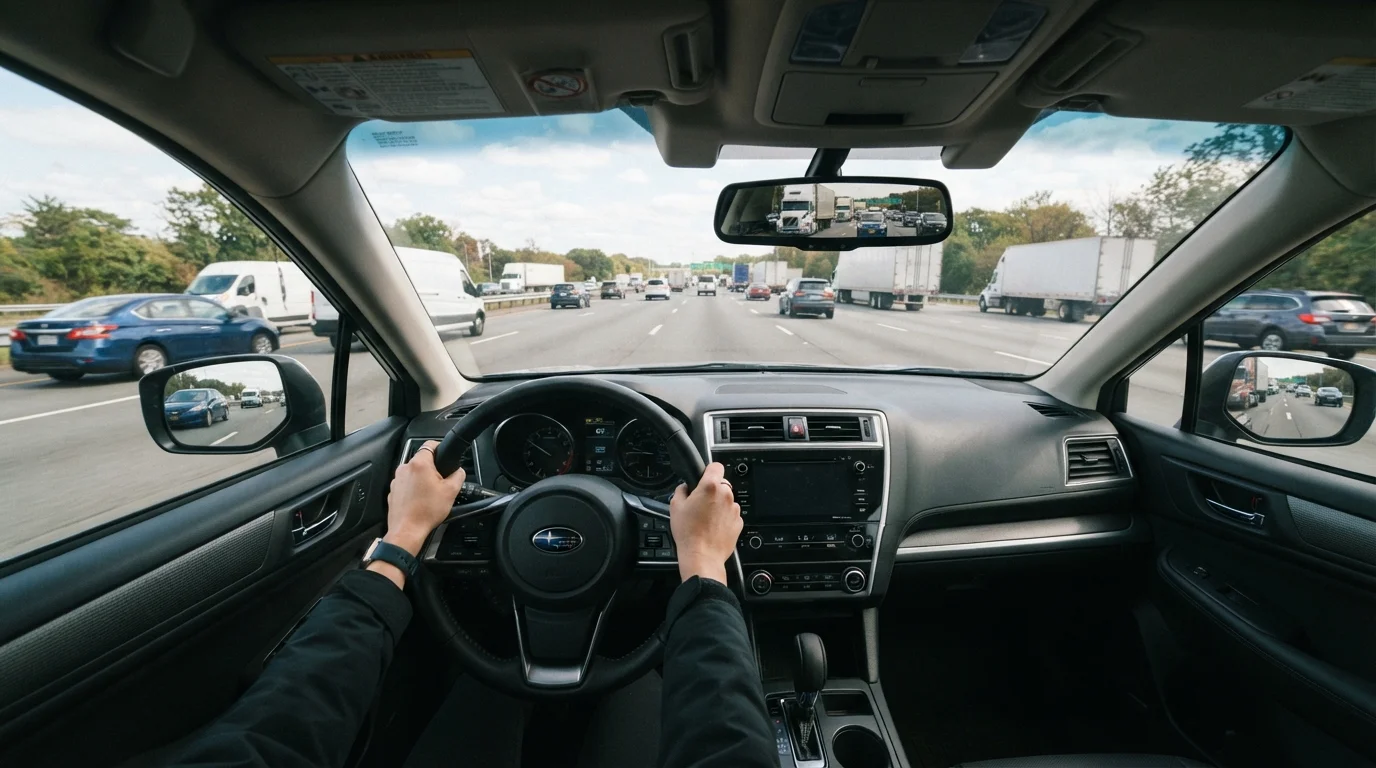
Mirror awareness is the habit of actively reading all three of your vehicle's mirrors — rearview and both side mirrors — to maintain a continuous, accurate picture of traffic around you. It goes beyond a quick glance; it means interpreting what each mirror shows and acting on that information in real time. Done well, it lets you anticipate hazards rather than react to them.
Each mirror covers a distinct zone. Blind spots exist where all three overlap imperfectly, which is why head checks and, where equipped, blind-spot monitoring systems are used alongside mirrors — not instead of them.
Three Mirrors, Three Different Jobs
Most drivers treat mirror-checking as a reflex — a quick scan before pulling out or switching lanes. But each mirror is actually giving you a distinct slice of information, and understanding what each one shows changes how you use them.
The rearview mirror sits in the center and is your primary tool for reading what's directly behind you. It tells you how fast following traffic is closing in, whether a vehicle is tailgating, and whether an emergency vehicle is approaching from behind. What it can't do is show you anything to the sides.
Your driver-side mirror covers the lane to your left and the area alongside the driver's door. This mirror is critical when merging onto highways, passing, or being passed. Because it's angled slightly outward, it shows a wider slice of your surroundings than the rearview.
Your passenger-side mirror does the same job on the right — but it also looks more distorted because it's convex (curved outward) to compensate for the extra distance from your eye. The small-print warning stamped on that mirror — "objects in mirror are closer than they appear" — is there for exactly this reason. Don't dismiss it.
5–8 sec
Recommended mirror scan interval while driving
This interval is a standard guideline taught in defensive driving courses across the US to maintain continuous situational awareness.
~20%
Of crashes involve lane changing or merging
According to NHTSA data, a significant share of multi-vehicle crashes occur during lane changes — situations where mirror use and blind-spot checks are most critical.
Why Mirror Adjustment Is Not a One-Time Task
A mirror that's aimed at the side of your own car is mostly showing you your own paint job. That's not useful. Properly adjusted mirrors should overlap slightly with each other's coverage zones, minimizing gaps — but the setup that works for one driver won't work for another if they don't share the same seat position or height.
Whenever someone else drives your vehicle, re-check your mirror alignment before you drive. The same applies after adjusting your seat significantly. The process takes about 30 seconds and meaningfully changes what you can see.
Reset Your Mirrors Every Time You Sit Down
Before you pull away, take a few seconds to verify your mirrors are aimed correctly for your current seat position. If another driver has used your vehicle, or if you adjusted your seat, the mirrors will likely need resetting. It's a small habit that pays off every single drive.
Well-set mirrors won't eliminate blind spots — the zones just off your rear quarter-panels where neither your rearview nor your side mirrors reach. A quick shoulder check before any lane change remains necessary. Think of mirrors as your first layer of awareness, and the shoulder check as your confirmation.
Reading Mirrors Together: Building a Full Picture
The real skill isn't using any single mirror — it's integrating what all three show you into one continuous mental map of surrounding traffic. Experienced drivers do this almost unconsciously, cycling through all three every few seconds.
Here's how to build that habit deliberately:
- Before braking: A quick rearview check tells you whether the car behind you has enough following distance to stop safely if you slow suddenly.
- Before a lane change: Check rearview, then the relevant side mirror, then do a shoulder check into the blind spot. In that order, every time.
- On the highway: Scan mirrors more frequently because speeds are higher and closing distances shrink fast. Gaps between checks should be shorter, not longer.
- When reversing: Side mirrors show what's alongside your vehicle — essential when parking in tight spots where a backup camera may not catch everything to the sides.
For a broader look at the routine checks that keep your vehicle safe and predictable on the road, see our guide on tyre pressure and the checks most drivers overlook.
What Your Mirrors Can't Tell You
Mirrors are powerful, but they have honest limits every driver should understand.
Blind-Spot Monitoring Has Limits Too
Many newer vehicles include blind-spot monitoring systems that alert you when a vehicle enters your mirror's gap zones. These are genuinely useful aids, but they typically respond to vehicles traveling at similar speeds and may not detect cyclists, pedestrians, or slow-moving objects in the same way. Treat them as an extra layer of awareness — not a replacement for mirror checks and shoulder glances.
Blind spots are the most obvious gap, but there are others. Mirrors don't show you pedestrians stepping off a curb to your immediate side, cyclists moving up on your right in traffic, or anything blocked by a large vehicle directly beside you. They also can't tell you what's around a curve ahead — only what's behind and beside you right now.
The takeaway isn't that mirrors are unreliable. It's that they work best when paired with good habits: consistent shoulder checks, appropriate following distance, and a genuine awareness that your view is always partial. No single tool — mirrors, cameras, sensors — gives you the full picture alone. Using them together does.
“Seeing is not the same as looking. Good drivers scan constantly — they're reading the road behind them as actively as the road ahead.”
— Tom Vanderbilt, Author of 'Traffic: Why We Drive the Way We Do'