

Key Takeaways
- The stress response is a normal, adaptive biological process — not a malfunction.
- Adrenaline triggers immediate physical changes; cortisol sustains and regulates the response.
- Chronic activation of this system, without recovery, is what creates lasting health risks.
- Simple habits can help signal to your nervous system that it is safe to down-regulate.
- Understanding the mechanics of stress makes evidence-based management strategies easier to apply.
The Stress Response
The stress response is a built-in biological reaction that prepares your body to deal with a perceived threat or challenge. It involves your brain signaling the release of hormones — primarily adrenaline and cortisol — that sharpen alertness, redirect energy, and prime your muscles for action. This system evolved to help humans survive immediate dangers and continues to activate during modern stressors like deadlines, conflict, or uncertainty.
Physiologically, the stress response is coordinated by the hypothalamic-pituitary-adrenal (HPA) axis and the sympathetic branch of the autonomic nervous system, working in parallel to regulate both short-term arousal and longer-term hormonal output.
The Two-Stage Alarm System
When your brain perceives a threat — whether a near-collision on the freeway or a tense conversation with your boss — two overlapping systems activate almost simultaneously.
The first is the sympathetic nervous system. Within seconds, it triggers the adrenal glands to release adrenaline (also called epinephrine). Heart rate climbs, breathing quickens, blood is redirected to large muscle groups, and pupils dilate. This is the classic fight-or-flight response: your body prioritizing immediate survival over everything else.
The second stage unfolds over minutes to hours. The hypothalamus signals the pituitary gland, which in turn prompts the adrenal cortex to release cortisol. Cortisol sustains the body's heightened state, influences blood sugar regulation, and temporarily modulates the immune system. Once the threat resolves, cortisol signals the brain to wind the system back down — a built-in off switch.
Not All Stress Looks the Same
People often assume stress must feel dramatic to be significant, but low-grade, persistent background stress — from commuting, financial uncertainty, or digital overload — also activates the HPA axis repeatedly throughout the day. Recognizing subtler stressors is an important first step toward managing overall stress load.
What's Actually Happening in Your Brain
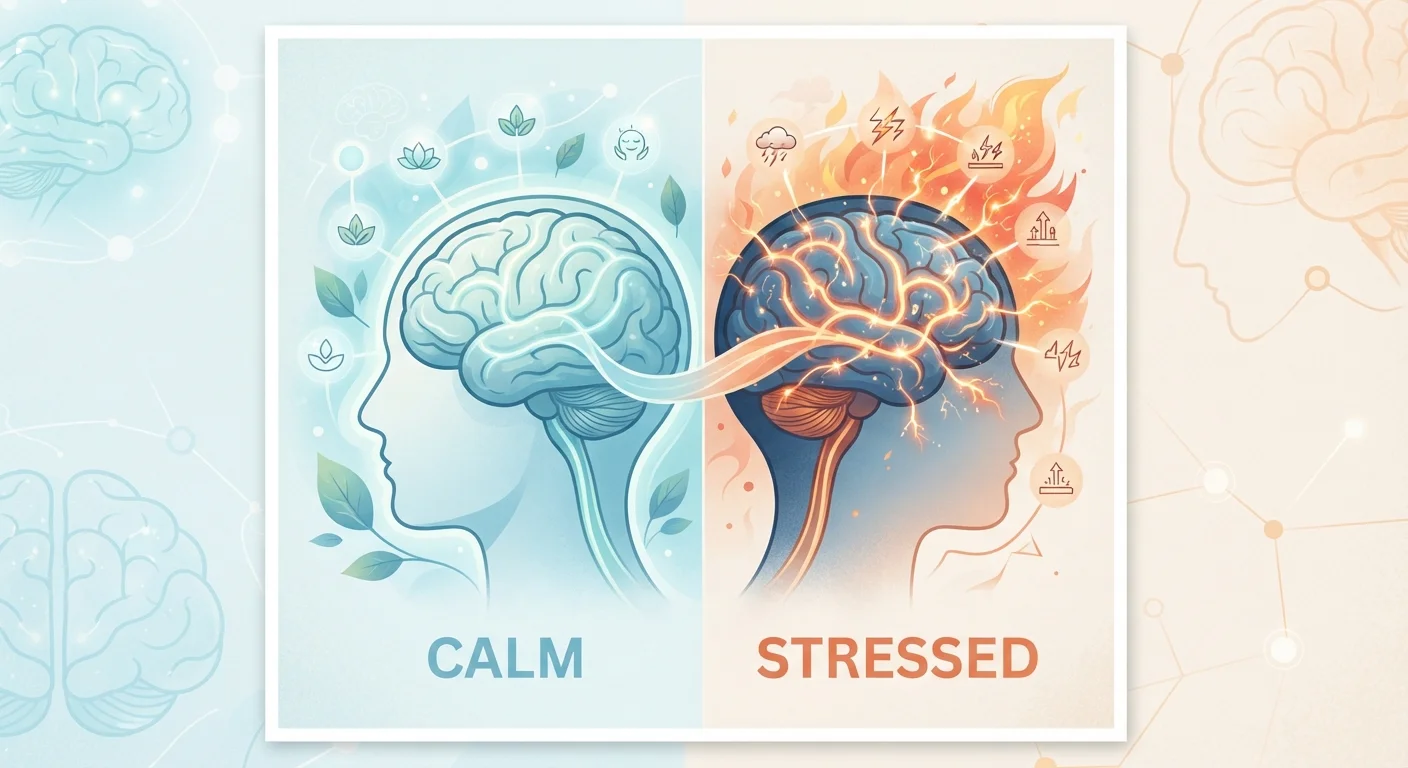
The amygdala — a small, almond-shaped structure deep in the brain — acts as the primary threat detector. It processes incoming sensory information and, when it flags something as dangerous, fires off distress signals before the rational prefrontal cortex has even finished evaluating the situation. This is why you might flinch at a loud noise before consciously registering what it was.
The prefrontal cortex, responsible for judgment and context, can eventually override or modulate that initial alarm — but this takes conscious effort and time. Under high stress, the prefrontal cortex effectively becomes less influential, which is why decision-making, creativity, and impulse control often suffer during intense stress.
“The amygdala's role is not to think — it is to react. It prioritizes survival signals and fires before deliberate reasoning has a chance to intervene. That architecture is a feature, not a flaw, but understanding it gives us more agency over our responses.”
— Lisa Feldman Barrett, Neuroscientist and Professor, Northeastern University
The hippocampus, which handles memory formation, is also acutely sensitive to cortisol. Brief elevations can sharpen memory for survival-relevant events; prolonged exposure, however, is associated in research with impaired memory consolidation.
Why Chronic Stress is the Real Problem
A single stress response is not inherently harmful — it is adaptive. The issue emerges when activation becomes near-constant without adequate recovery time. Research consistently links chronically elevated cortisol to:
- Disrupted sleep patterns
- Increased cardiovascular strain over time
- Suppressed immune function
- Heightened risk of mood disorders
- Digestive and metabolic changes
77%
Americans reporting physical stress symptoms
According to the American Psychological Association's Stress in America survey, a large majority of U.S. adults report experiencing physical symptoms they associate with stress.
2–3x
Higher cardiovascular risk linked to chronic stress
Research published in cardiovascular health literature suggests persistently elevated stress hormones are associated with meaningfully higher risk of hypertension and related conditions over time.
20 min
Typical cortisol elevation after acute stressor
Studies on cortisol recovery indicate levels often begin declining within roughly 20–60 minutes after the stressor ends, though this varies significantly by individual and stressor type.
The key insight is that the body needs to fully complete the stress cycle — reaching genuine physiological calm — before the next stressor arrives. Without that recovery, the system stays primed. Our detailed look at how stress affects your body and mind explores these downstream effects further.
Practical Ways to Support Recovery
Understanding the biology makes the why behind stress-management strategies clearer. These approaches work by actively engaging the parasympathetic nervous system — the body's rest-and-digest counterpart to fight-or-flight.
Try the Extended Exhale Technique
Inhale for a count of four and exhale for a count of six to eight. This ratio activates the vagus nerve and signals the parasympathetic system to take over. Even three to five cycles during a tense moment can produce a measurable shift in how alert or calm you feel.
Slow, diaphragmatic breathing is one of the most direct ways to activate the parasympathetic system. Extending the exhale slightly longer than the inhale sends signals through the vagus nerve that it is safe to down-regulate.
Physical movement helps discharge the neurochemical byproducts of the stress response — the body was designed to complete the stress cycle through action, not stillness alone.
Consistent daily structure also plays a role. A predictable routine reduces the number of micro-stressors your brain has to process. See our guide to building a daily routine that supports emotional balance for practical steps. For those interested in specific practices, journaling, meditation, and breathwork each offer evidence-informed pathways to calmer baseline states.
This article is for general informational and educational purposes only and is not a substitute for professional medical advice, diagnosis, or treatment. Always consult a qualified healthcare provider about any health concerns or before making changes to your health routine.