

Key Takeaways
- The plate method divides meals visually into food groups without requiring calorie tracking.
- Filling half your plate with vegetables and fruit naturally limits calorie-dense foods.
- Protein and whole grains improve satiety, reducing the urge to overeat between meals.
- Mindful eating cues — hunger, fullness, and pace — are as important as what you serve.
- Small, consistent plate habits are more sustainable than rigid calorie counting.
What you will need
Why Calorie Counting Often Falls Short
Calorie tracking apps and food diaries have helped many people understand their eating patterns, but they come with real friction: the method requires consistent logging, accurate label reading, and ongoing mental load. For many people, that burden doesn't hold up across months or years of daily life.
More importantly, calories alone don't capture food quality. Two meals with identical calorie counts can differ dramatically in fiber, protein, micronutrients, and satiety — all of which affect how hungry you feel an hour later and how your body functions over time. Research on dietary patterns increasingly focuses on food quality and meal structure rather than pure energy arithmetic.
That's where visual, structure-based approaches become practical. If you want to understand what labels are actually communicating, our plain-English guide to reading nutrition labels is a useful companion. And if you're curious about which everyday habits quietly work against good nutrition, see common eating patterns that undermine a balanced diet.
This Is General Nutrition Education
The guidance in this article is for general informational purposes and is not a substitute for personalized medical or dietetic advice. Individual nutrition needs vary based on age, health status, activity level, and medical conditions. Please consult a registered dietitian or qualified healthcare provider before making significant changes to your diet.
How to Build a Balanced Plate — Step by Step
The following steps are based on the plate method, a well-established visual framework used in public health nutrition education. No tracking app is required. The only tool you need consistently is a standard-sized dinner plate.
What you will need
A standard 9-inch dinner plate
Used as the visual template for dividing food groups proportionally at each meal.
Measuring cups (set)
Helpful during an initial learning phase to build an accurate sense of portion sizes before estimating by eye.
A food journal or notes app
Recording meals for a few days helps identify patterns without requiring permanent calorie logging.
Divide Your Plate Into Three Visual Zones
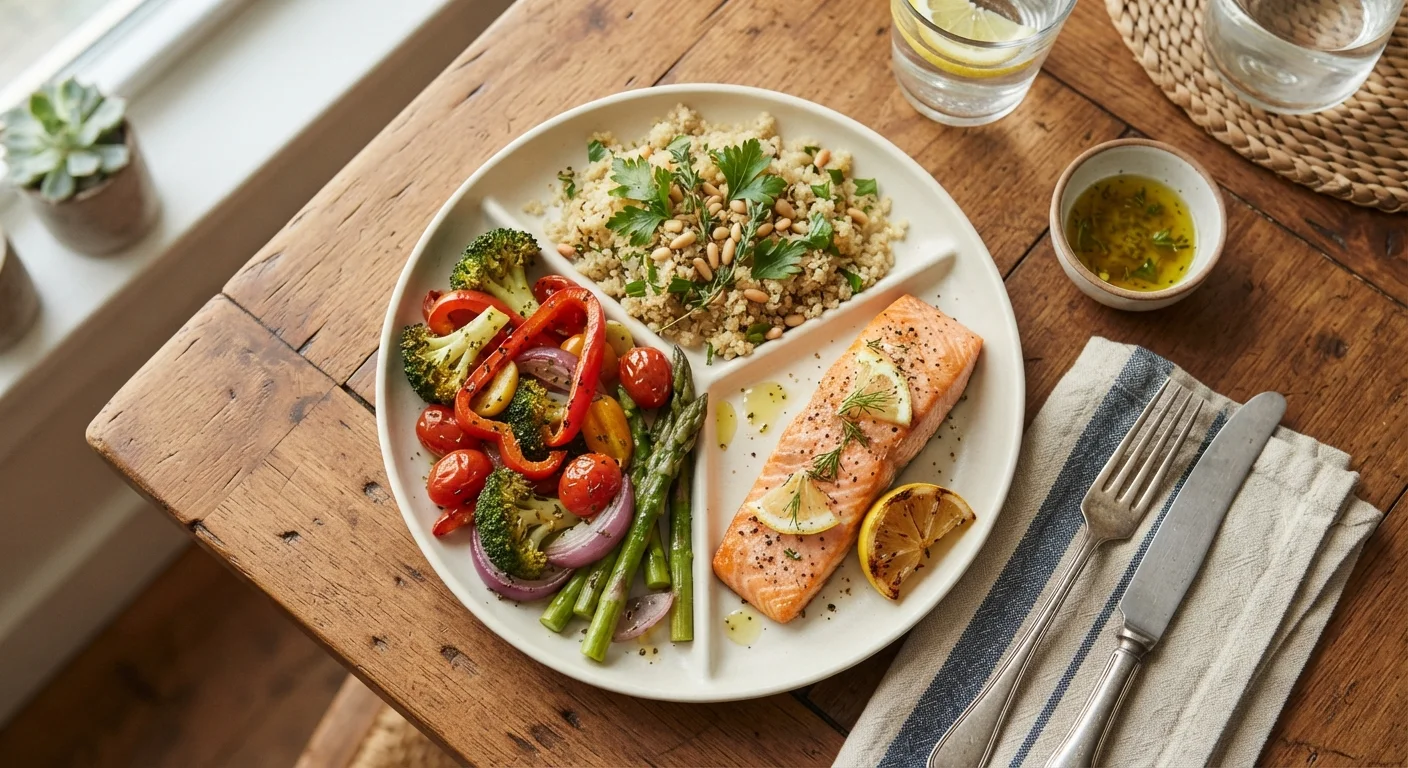
Before serving any food, mentally divide your plate in half, then split one half in two. The large half is reserved for non-starchy vegetables (and fruit at some meals). One quarter holds a lean or plant-based protein. The remaining quarter is for whole grains or starchy vegetables like sweet potatoes or legumes.
This structure — popularized in part by the USDA's MyPlate framework — mirrors patterns found in research on dietary quality and long-term health outcomes. It doesn't demand perfection at every meal, only a general directional habit.
Fill the Vegetable Half First
Serving vegetables before other components changes what ends up on your plate. High-fiber, high-water-content vegetables — leafy greens, broccoli, peppers, zucchini, tomatoes — add volume and nutrients with relatively low energy density. This naturally leaves less room for calorie-denser foods without requiring any arithmetic.
Variety matters for nutritional coverage. Rotating colors (dark greens, oranges, reds, purples) broadly corresponds to rotating the vitamins, minerals, and phytonutrients your body uses.
Choose a Protein That Keeps You Full
Protein has a stronger satiety effect per calorie than either fat or carbohydrate, meaning a properly sized protein portion reduces hunger over the hours that follow. Options include eggs, fish, poultry, tofu, tempeh, legumes, or low-fat dairy. Variety across protein sources also broadens your amino acid and micronutrient intake.
The goal at this step is to fill the protein quarter genuinely — not a symbolic sliver — so that the meal sustains you through to the next one.
Select Whole Grains or Starchy Vegetables for the Final Quarter
Whole grains — brown rice, quinoa, whole-wheat pasta, oats, barley — retain fiber and nutrients that are removed in refining. Fiber slows digestion, moderates blood sugar response, and contributes to fullness. The same applies to starchy vegetables like sweet potatoes, corn, and legumes serving double duty as protein and starch.
Limiting this zone to one quarter of the plate — rather than letting grains dominate — is one of the simplest structural shifts in transitioning toward a more balanced eating pattern.
Eat Slowly and Check In With Hunger Cues
The plate method addresses what you eat; mindful eating addresses how. Slowing your pace gives your brain time to register satiety signals, which trail behind actual fullness by roughly 15–20 minutes. Practical ways to slow down include putting utensils down between bites, removing screens from mealtime, and pausing halfway through to assess hunger on a simple scale.
These behavioral habits are distinct from plate composition but compound its effects — research consistently links slower eating with lower overall intake and greater meal satisfaction.
Use Everyday Objects as Portion Guides
Your fist is roughly equivalent to one cup — a practical guide for grains or vegetables. A palm-sized portion approximates a standard protein serving. These rough benchmarks aren't precise, but they build intuition without requiring any measuring equipment.
Portion Frameworks Are Not One-Size-Fits-All
General portioning guidelines like the plate method are designed for healthy adults and may not be appropriate for people managing diabetes, kidney disease, eating disorders, or other conditions that require medically supervised meal planning. Always seek professional guidance if you have a diagnosed health condition.
For a broader look at how these principles fit into everyday eating, see practical principles for building a balanced plate. It's also worth being aware of how food packaging language can create a false sense of health — our piece on nutrition label myths that mislead careful shoppers covers common traps.
Pairing good eating habits with consistent movement amplifies the benefits of both. Our Fitness & Movement hub offers approachable strategies for building activity into everyday life.
This article is for general informational and educational purposes only. It does not constitute medical or dietary advice. Consult a registered dietitian or qualified healthcare professional for guidance specific to your health needs.