

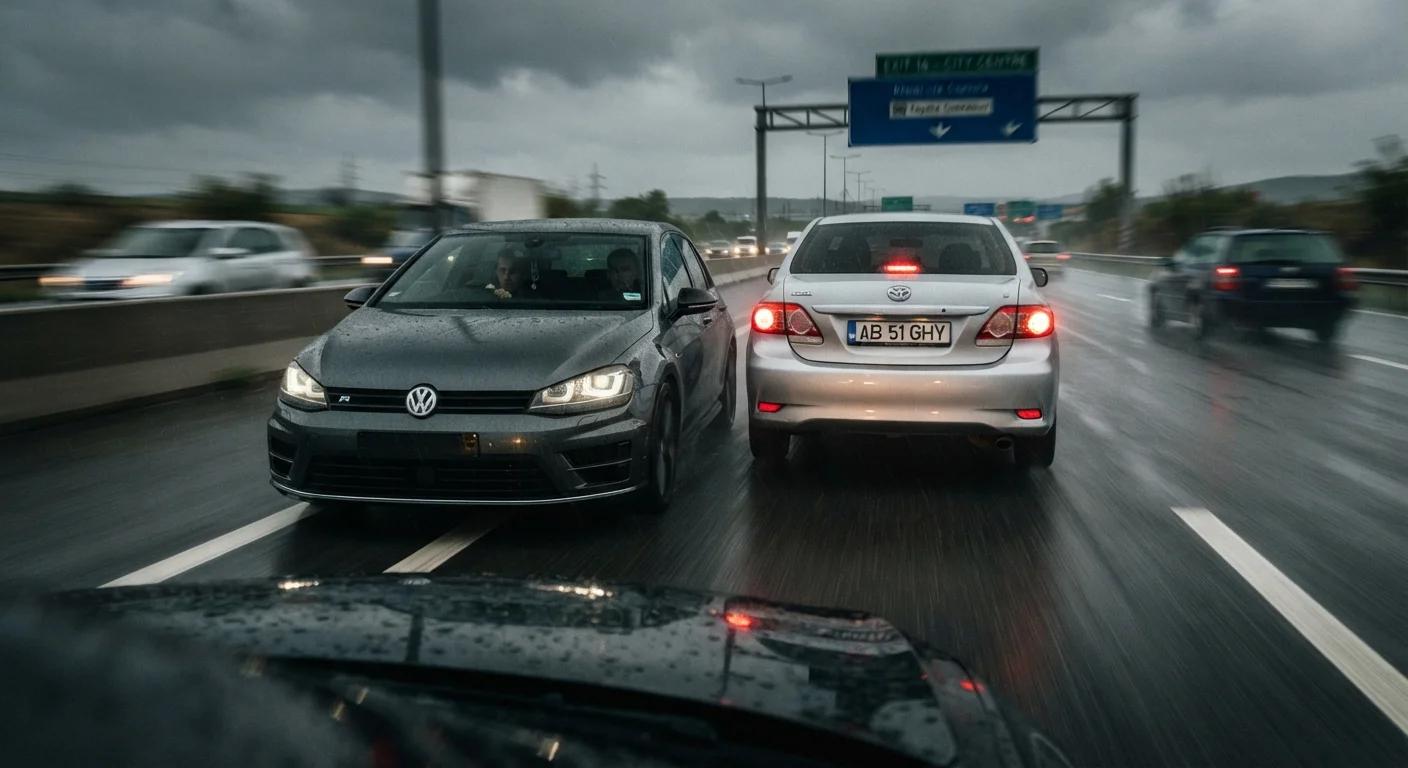
Key Takeaways
- At 60 mph, a typical driver needs around 240 feet to stop — tailgating eliminates that buffer entirely.
- Most tailgating happens unconsciously, driven by traffic flow and distraction rather than aggression.
- The two-second following rule is a minimum; wet or poor-visibility conditions demand more space.
- Consistent spacing habits reduce rear-end collision risk significantly for everyday drivers.
The Physics Behind Following Distance
Tailgating feels low-stakes until it isn't. The core problem is physics: your vehicle doesn't stop the instant you press the brake pedal. There are two phases at work — reaction time (the gap between seeing a hazard and pressing the brake) and braking distance (the distance your car travels while actually stopping).
At 60 mph, average reaction time alone accounts for roughly 66 feet of travel before braking even begins. Add braking distance on dry pavement and you're looking at well over 200 feet to a complete stop. Close that gap to a single car length and there is simply no room to respond — the math doesn't work in your favour.
Wet roads make this significantly worse. Water reduces tyre grip, extending braking distances by 50% or more depending on tread depth and road condition. If your tyres are already marginal, the situation deteriorates faster than most drivers expect. See our guide to tyre checks for the maintenance side of this equation.
~23%
Of all US crashes involve rear-end collisions
According to the National Highway Traffic Safety Administration (NHTSA), rear-end collisions are among the most common crash types on American roads.
50%+
Increase in stopping distance on wet roads
Industry safety guidance consistently notes that wet pavement can extend braking distances by half or more compared to dry conditions, depending on speed and tyre condition.
Why Drivers Tailgate Without Realising It
Most tailgating isn't road rage. Research into driver behaviour consistently finds that the majority of following-too-closely incidents involve drivers who simply aren't aware of how close they are. Several factors explain this:
- Speed normalisation: After extended highway driving, high speeds feel routine and distances compress perceptually. What looks like a comfortable gap at 40 mph is dangerously tight at 70 mph.
- Traffic pressure: When traffic is dense, drivers unconsciously match the spacing around them — even when that collective spacing is unsafe.
- Distraction: Even brief attention lapses cause drivers to drift closer without noticing. Hands-free calls, navigation adjustments, and passenger conversations all contribute.
- Overconfidence in braking: Many drivers overestimate how quickly modern brakes stop a vehicle, especially when loaded or on worn tyres.
Distraction Shrinks Your Effective Reaction Time
Even a one-second distraction at 60 mph means your vehicle travels 88 feet before you've registered a hazard. Combined with tailgating, this leaves essentially no margin for error. Keeping your eyes on the road and your following distance generous are two habits that reinforce each other — reducing one undermines the other.
Night driving adds another layer of complexity. Reduced visibility shortens the distance at which you can identify hazards, meaning your effective reaction window shrinks even further. Our article on night driving myths covers how perception changes after dark.
Common Tailgating Mistakes and How to Correct Them
Using car lengths instead of time to judge following distance.
Why it happens: Car lengths feel like a concrete, visual measure. But a 'safe' number of car lengths at 30 mph becomes dangerously short at 65 mph.
Closing the gap when another car merges into your following space.
Why it happens: Drivers instinctively feel that someone 'taking' their buffer is an encroachment, and they respond by shortening the gap to the new vehicle ahead.
Maintaining highway following distances when entering stop-and-go traffic.
Why it happens: Drivers don't always recalibrate when speed drops significantly, particularly during gradual traffic slowdowns where the change is incremental.
Tailgating in poor weather without adjusting for longer stopping distances.
Why it happens: Drivers often apply dry-road habits directly to wet or icy conditions, underestimating how dramatically grip loss extends stopping distance.
Focusing on the vehicle directly ahead rather than the broader traffic picture.
Why it happens: It's natural to fixate on the nearest hazard. But reacting only to the car ahead means you get no early warning from events further up the road.
Building a Spacing Habit That Sticks
The widely taught two-second rule — choosing a fixed roadside marker and ensuring two full seconds pass between the car ahead passing it and you reaching it — is a practical minimum on dry roads at moderate speeds. Extend this to three or four seconds in rain, fog, or heavy traffic. On the highway above 60 mph, four seconds is a more defensible buffer.
In wet conditions especially, the combination of longer braking distances and reduced tyre grip means your spacing assumption from a dry-road day may no longer apply. Adjusting your approach in heavy rain covers this in more depth, including how visibility changes affect judgment.
Rear-End Collisions Are Rarely Truly Sudden
Most rear-end crashes are the result of inadequate following distance, not an unavoidable event. Investigators frequently find that the driver had sufficient time to stop if spacing had been appropriate. Consistently maintaining space ahead of your vehicle is one of the highest-value safety habits you can build — it costs nothing and compounds over a lifetime of driving.
One practical mental shift: stop thinking about following distance in terms of car lengths and start thinking in seconds. Car lengths feel intuitive but they scale poorly with speed. Seconds-based spacing scales automatically — the faster you go, the more physical distance two seconds represents.
This article is for general informational purposes. Always follow applicable traffic laws and posted speed limits in your state.