

Key Takeaways
- Annuals complete their entire life cycle in one growing season and must be replanted each year.
- Perennials die back in winter but regrow from their roots each spring for multiple seasons.
- Annuals generally provide more consistent bloom color; perennials tend to bloom in defined windows.
- Combining both types gives you a garden with structural depth and reliable seasonal interest.
- Planting timing differs: annuals go in after frost, perennials can often be planted in fall or early spring.
Option A
Annuals
The high-impact, one-season performer.
Best for: Gardeners who want bold, continuous color and the flexibility to change their planting scheme each year.
Option B
Perennials
The reliable, long-term garden investment.
Best for: Homeowners looking to build a low-maintenance garden framework that returns and expands year after year.
If you want continuous, season-long color with flexibility to change things up
Annuals
Annuals bloom reliably from planting until frost, and replanting each year lets you experiment with new colors and layouts.
If you want a lower-maintenance garden that builds on itself over time
Perennials
Perennials return each spring and gradually spread, reducing your replanting work and upfront cost over several years.
If you're planning a new garden bed from scratch
Perennials
Establishing perennials first creates a structural backbone that you can then fill in with annuals for seasonal color accents.
If you're gardening in containers or filling gaps mid-season
Annuals
Annuals transplant easily into pots and bare spots, giving you quick visual results without long-term soil commitment.
What Actually Makes a Plant Annual or Perennial
The terms refer to a plant's natural life span — not how it performs or how much care it needs. An annual germinates, flowers, sets seed, and dies all within a single growing season. It puts nearly all its energy into producing blooms, which is why annuals tend to flower abundantly. Common examples include marigolds, zinnias, petunias, and impatiens.
A perennial lives for more than two years. Above-ground growth typically dies back after the first hard frost, but the root system survives underground and pushes up new growth the following spring. Coneflowers, black-eyed Susans, daylilies, and hostas are familiar perennials in most US home gardens.
There's also a middle category worth knowing: biennials, which complete their cycle over two years — growing foliage the first year and flowering the second. Foxglove and hollyhock are common examples. For practical planning purposes, most gardeners treat biennials more like short-lived perennials.
| Criterion | Annuals | Perennials |
|---|---|---|
| Life span | One growing season | 3+ years |
| Bloom duration | All season until frost | Defined window (weeks) |
| Replanting required | Every year | Rarely |
| Upfront cost | Lower per plant | Higher per plant |
| Long-term cost | Higher (annual purchase) | Lower (self-renewing) |
| Best planting time | After last frost (warm-season) | Fall or early spring |
| Flexibility | High — change yearly | Lower — more permanent |
| Maintenance level | Moderate (deadheading, watering) | Low to moderate (dividing) |
Timing: When to Plant Each Type
Planting timing differs meaningfully between the two categories, and getting it right is one of the most practical skills a home gardener can develop.
Annuals are frost-sensitive. Cool-season annuals like pansies and snapdragons can go in during early spring or fall when temperatures are mild, but warm-season annuals — zinnias, marigolds, impatiens — should not go in the ground until all danger of frost has passed in your area. Check your local last-frost date before planting.
Perennials are more flexible. Fall planting is often recommended because cooler soil temperatures encourage root development before winter. Spring planting works too, especially for bare-root perennials. The key rule: give perennials time to establish before they face either summer heat stress or winter freeze. As a general guide, aim for at least six weeks before the ground hardens.
For a deeper look at setting your garden up for seasonal transitions, see our guide on getting your yard ready as the growing season ends.
3–5 years
Typical payoff window for perennial beds
Garden planning resources widely note that perennial beds begin to outperform annuals in cost-efficiency within three to five growing seasons as plants mature and divide.
2–3x
How often perennial clumps can be divided
Many perennials double in clump size every two to three years, allowing gardeners to divide and multiply their plants at no additional cost.
Cost, Effort, and Long-Term Value
Annuals require a financial and time investment every single year. You purchase new transplants or seeds each spring, which adds up — especially if you're covering large beds. On the upside, you're never locked into a layout; it's easy to pivot color schemes or plant varieties seasonally.
Perennials carry a higher upfront cost per plant, but that investment pays dividends. A healthy perennial clump often doubles in size every few years and can be divided to fill more garden space at no additional cost. Over a three-to-five-year horizon, a perennial bed typically costs less to maintain than an equivalent annual bed.
Effort-wise, annuals demand more frequent deadheading and watering to keep blooms coming. Perennials need dividing every few years to prevent overcrowding but generally require less season-to-season intervention. Pairing either type with a good layer of mulch reduces watering demands and suppresses weeds — see what mulch actually does for your garden for practical guidance.
Regional Hardiness Affects Perennial Survival
Whether a plant truly behaves as a perennial depends on your local climate. A plant labeled perennial in USDA Hardiness Zones 7–9 may not survive winters in Zone 5. Always check a plant's hardiness zone range against your own zone before purchasing. Your local cooperative extension service is a reliable free resource for region-specific planting guidance.
How to Combine Both for a Better Garden
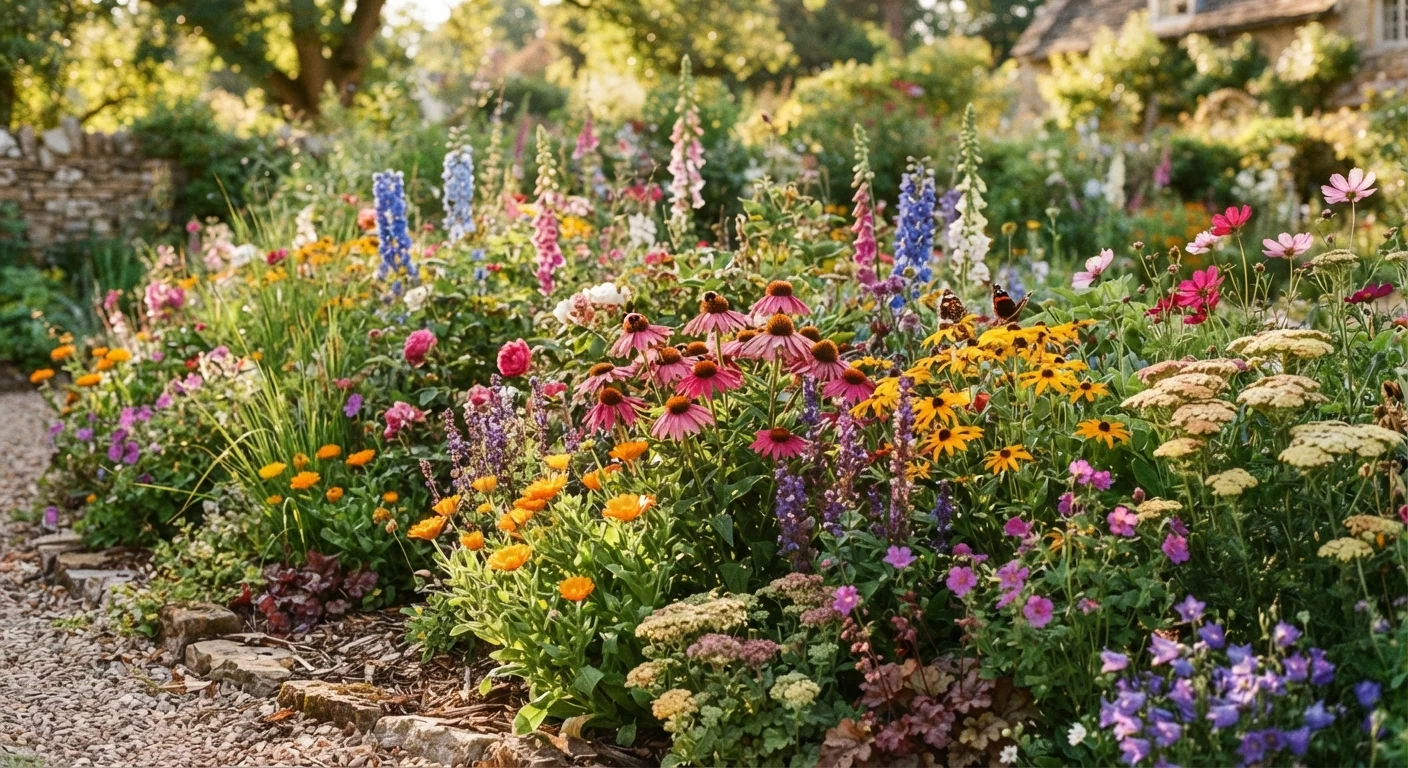
Most experienced home gardeners don't choose one over the other — they design with both. A common and effective approach is to build the bed's structure around perennials, then use annuals to fill gaps and extend color during periods when perennials aren't blooming.
For example: coneflowers and black-eyed Susans might anchor a sunny bed in midsummer, while annuals like salvias or zinnias bridge the gaps in early summer and early fall. This layered approach means something is almost always in bloom from late spring through the first frost.
When planning, consider bloom time, plant height, and sun requirements for each plant regardless of its annual or perennial status. Taller plants toward the back, shorter ones at the front — the same design logic applies to both categories. If you're starting a brand-new bed, our beginner's guide to starting a garden from scratch covers the soil and site fundamentals you'll want in place first. You can also explore designing a backyard that actually works for you for ideas on integrating planting beds into your overall outdoor layout.