

Key Takeaways
- Decluttering before buying storage prevents doubling down on unused items.
- Vertical storage dramatically increases capacity without shrinking floor space.
- Multi-functional furniture is the single biggest space multiplier in small homes.
- Defined zones create a sense of order even in open-plan studios.
- Consistent daily habits prevent clutter from returning after an initial sort.
Start With a Clear-Out, Not a Shopping Trip
The instinct when a small home feels cramped is to reach for more storage bins, baskets, or shelving. Resist it. Buying more containers before reducing what you own typically compounds the problem — you end up with the same number of things, now sorted into more boxes that still compete for the same limited space.
Begin with an honest audit of every room. Pull items out category by category and ask two questions: Is this used regularly? Does it justify the space it occupies? Anything that fails both tests is a candidate for donating, rehoming, or discarding. Our room-by-room decluttering guide walks through a repeatable process for doing this systematically.
Pay particular attention to duplicates, impulse purchases, and items kept out of obligation rather than use. In a small home, every object competes directly with comfort — the less you keep, the more breathing room remains.
Clear First, Then Decide on Storage
Sort everything out of a space before introducing any new containers or organising products. Once you see exactly what remains and how much of it there is, you'll make far more accurate decisions about what storage — if any — is actually needed.
Think Vertically to Unlock Wall Space
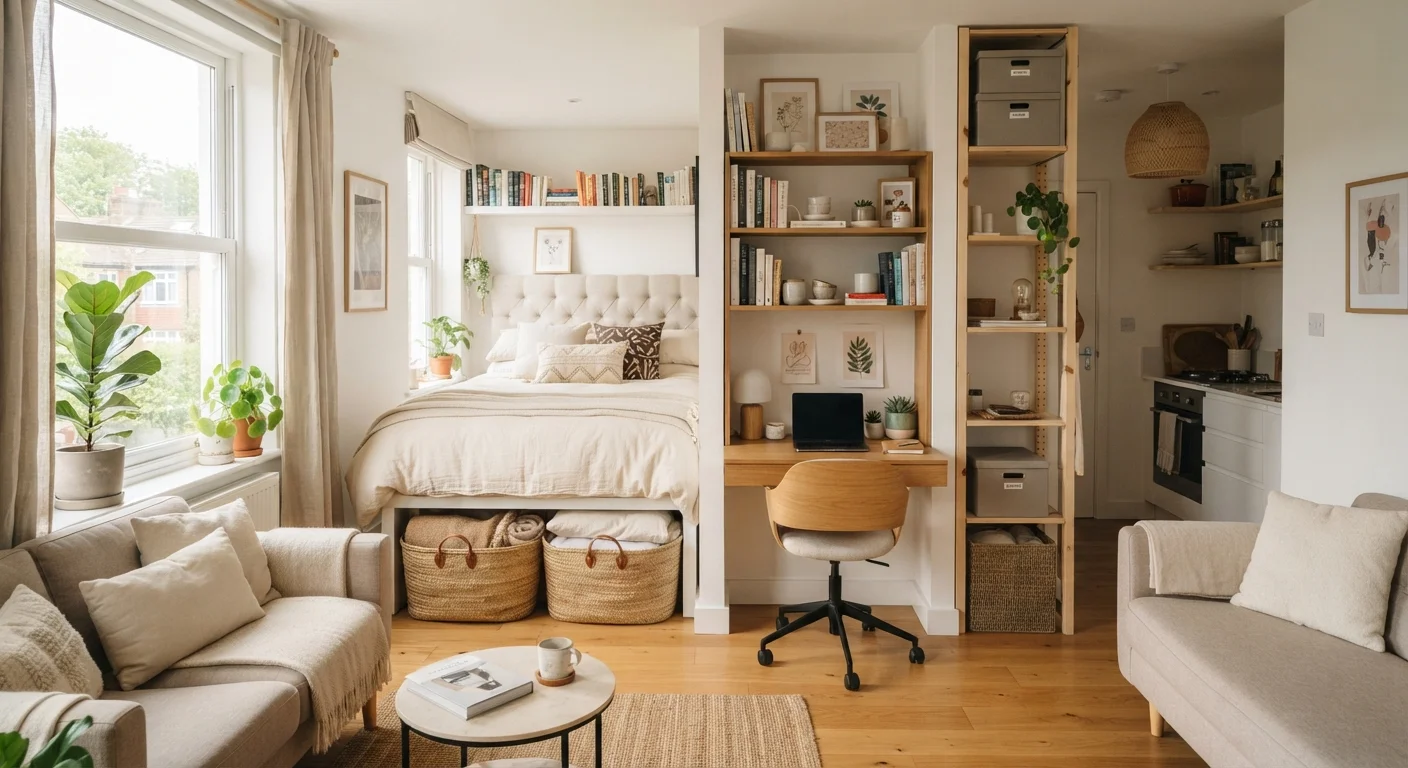
Floor space is the scarcest resource in a compact home, but walls are often left bare from shoulder height upward. Treating walls as usable storage dramatically expands capacity without consuming a single square foot of floor area.
Floating shelves above doorways, tall bookshelves that reach close to the ceiling, pegboards in kitchens and entryways, and wall-mounted hooks in hallways are all low-cost interventions that meaningfully increase storage. The principle is simple: store items at eye level and above so surfaces stay clear.
1 in 3
US renters live in units under 800 sq ft
Based on US Census Bureau housing data, a significant share of renters occupy compact apartments and studios where space efficiency is essential.
Up to 40%
Of usable wall height left empty in typical homes
Interior design practitioners commonly note that storage planning rarely extends above eye level, leaving substantial vertical capacity unused.
Understanding when to go vertical versus horizontal depends on the room and the contents. Our article on vertical vs. horizontal storage covers how to match the approach to each specific area of your home.
Also worth exploring: the spaces you likely overlook entirely. The backs of cabinet doors, the area under the stairs, and the gap beneath beds are all candidates for quiet expansion. See our guide on hidden storage spots most households overlook for a full rundown.
When mounting shelves, aim for the highest practical height first — store rarely-used items at the top and everyday items at arm's reach. This keeps the visual field below eye level clear and calm.
Visual clutter at eye level contributes heavily to a space feeling chaotic. Pushing infrequently accessed items overhead reduces perceived disorder without reducing capacity.
Use consistent, uniform containers on open shelves — matching sizes and colours visually quiet a storage area and make it read as intentional rather than cluttered.
Variety in container shapes and colours draws the eye and reads as disorder, even when items are technically organised. Visual uniformity signals intentionality.
Furniture That Earns Its Place
In a small home, every piece of furniture should justify its footprint by serving more than one purpose. A bed with built-in drawers beneath it replaces a separate dresser. An ottoman with interior storage doubles as seating and a blanket chest. A wall-mounted fold-down desk disappears entirely when not in use.
When evaluating furniture, ask whether the piece could do two jobs instead of one. If it can't, consider whether a dual-purpose alternative would free up meaningful space elsewhere in the room.
Avoid Overcrowding With Multi-Use Pieces
Multi-functional furniture is valuable, but adding too many large pieces in pursuit of storage can make a small room feel cluttered and harder to move through. Prioritise two or three genuinely dual-purpose items rather than filling every corner. Flow and clearance matter as much as capacity.
Keep sightlines in mind as well. Low-profile furniture and pieces with exposed legs create a visual sense of openness — the room appears larger because more floor is visible. Bulky, solid-base furniture tends to make a room feel more enclosed, even when the actual footprint is similar.
Zone Your Space Without Walls
Studios and open-plan layouts present a particular challenge: without physical separation, a single room must function as a living area, sleeping space, workspace, and sometimes dining room simultaneously. The solution isn't construction — it's deliberate zoning through furniture placement, rugs, and lighting.
An area rug anchors a seating group and signals that this corner is the living zone. A bookshelf positioned perpendicular to a wall creates a soft divider between sleeping and living areas without blocking light or airflow. A pendant light or floor lamp positioned above a chair defines a reading nook without any structural change.
Zoning Works in Any Layout
Even in a single room with a fixed furniture arrangement, using different textures, lighting tones, and rug placement can create a strong psychological sense of separate zones. You don't need square footage — you need visual distinction between areas.
Consistent zoning also makes tidying faster. When each activity has a designated space, items return to a specific location rather than drifting across the apartment — which is one of the most underrated factors in maintaining a tidy small home.
Habits That Keep Small Spaces Tidy Long-Term
Organisation methods work until life interrupts them — and in small homes, clutter rebounds faster because there's less buffer space to absorb it. Long-term tidiness depends less on systems and more on a handful of low-effort daily habits.
The most effective single habit is the one-in-one-out rule: whenever something new enters the home, something of comparable size leaves. It's a simple constraint that prevents gradual accumulation. Our piece on why the one-in-one-out rule works explains the reasoning behind it and how to make it stick.
Supplementing that with a seasonal review keeps the system honest. A room-by-room seasonal audit catches creeping accumulation before it becomes overwhelming — a quick pass four times a year is far less demanding than a major declutter every few years.
“A small home doesn't require less — it requires more thought. The difference between a cramped space and a comfortable one is almost always intentionality, not square footage.”
— Sarah Susanka, Architect and author of 'The Not So Big House'
Finally, build a short reset routine into the end of each day — five minutes to return items to their zones, clear surfaces, and reset the space. In a small home, five consistent minutes prevents the kind of drift that otherwise takes a full weekend to undo.