

| Legal minimum tread depth (US) | 2/32 inch (NHTSA tyre safety guidelines) |
| Recommended tyre rotation interval | Every 5,000–7,500 miles (General industry guidance; check your owner's manual) |
| Most common cause of tyre wear | Incorrect inflation pressure |
| Alignment check frequency | Annually or after a significant impact (General industry guidance) |
| Tyres to inspect visually | All four, including the spare |
How to Read Your Tyres Like a Mechanic
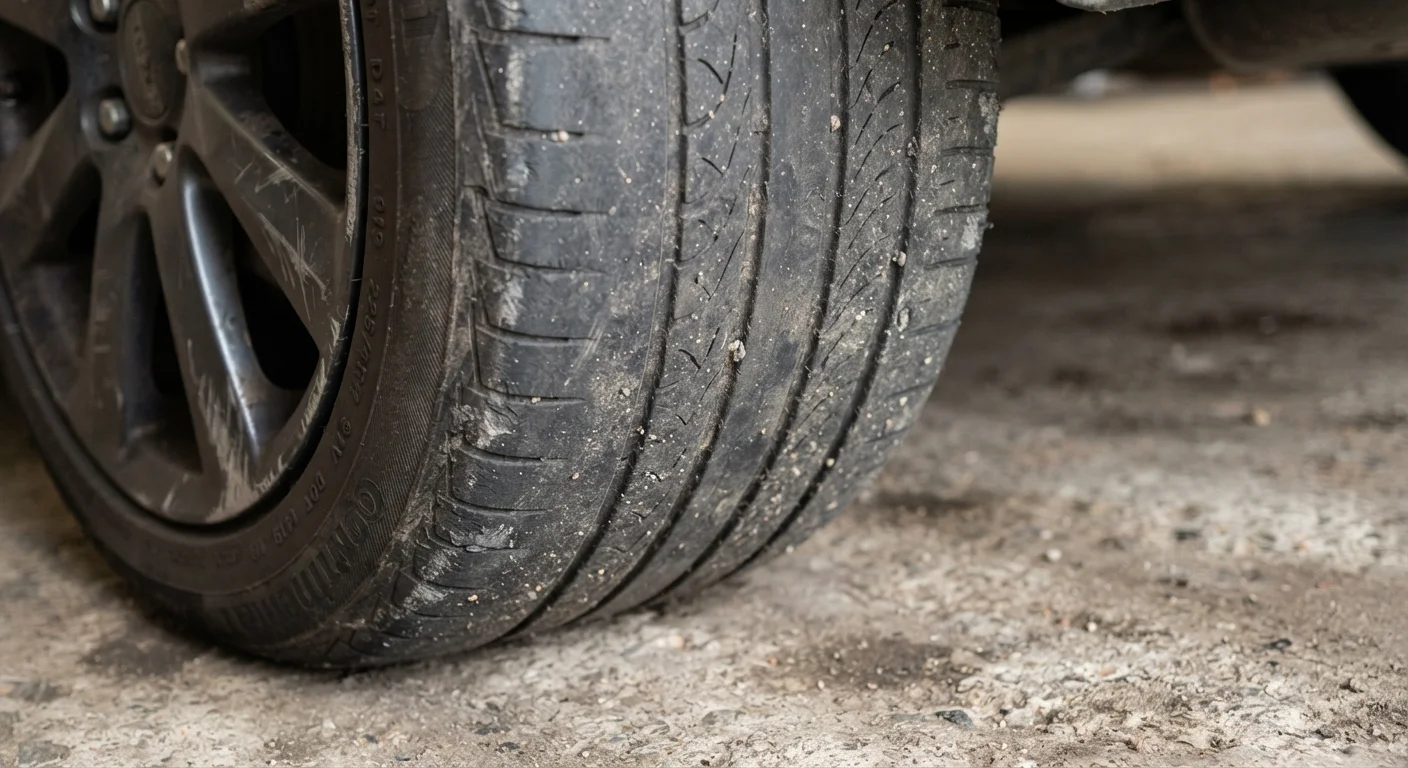
Most drivers glance at their tyres and think in binary terms: worn out or not worn out. But the pattern of wear tells a much more specific story. Uneven tread rarely happens by accident — it's usually the result of a correctable mechanical issue. Learning to recognize the main wear patterns takes about 60 seconds per tyre and can save you from a blowout, a failed inspection, or an expensive repair bill down the road.
Start with a visual sweep of each tyre from the front and the sides. Look for differences between the inner edge, center, and outer edge of the tread. Then compare wear levels between the front and rear tyres. Any significant inconsistency is worth investigating.
| Legal minimum tread depth (US) | 2/32 inch (NHTSA tyre safety guidelines) |
| Recommended tyre rotation interval | Every 5,000–7,500 miles (General industry guidance; check your owner's manual) |
| Most common cause of tyre wear | Incorrect inflation pressure |
| Alignment check frequency | Annually or after a significant impact (General industry guidance) |
| Tyres to inspect visually | All four, including the spare |
Common Wear Patterns and Their Causes
Center Wear
The center of the tread is wearing faster than the edges. Cause: overinflation. When a tyre is inflated above the recommended pressure, the tread bows outward in the middle, putting more contact on the center strip. See our tyre pressure guide for how to check and correct pressure.
Edge Wear (Both Sides)
Both inner and outer edges are wearing faster than the center. Cause: underinflation. A soft tyre flexes excessively, spreading the contact patch so the edges bear most of the load. This is probably the most common wear pattern and one of the most dangerous, since underinflated tyres generate excess heat.
One-Sided Edge Wear
Only one edge — inner or outer — is wearing faster than the rest. Cause: alignment issue, specifically camber. Camber refers to the inward or outward tilt of the tyre when viewed from the front. Excessive positive or negative camber causes the tyre to lean, loading one edge disproportionately. A wheel alignment service corrects this.
Cupping or Scalloping
Tread that dips and rises in a wavy, uneven pattern around the tyre's circumference. Cause: worn shocks or struts. When a shock absorber loses its damping ability, the wheel bounces against the road rather than rolling smoothly. The tyre skips, and each skip wears a dip into the tread. Cupped tyres also create a noticeable rumbling noise at highway speeds.
Feathering
Tread blocks that feel sharp on one side and rounded on the other when you run your hand across them. Cause: toe misalignment. Toe misalignment means the tyres are scrubbing sideways as they roll, rather than tracking straight. Like camber, this is corrected with a professional alignment.
Camber
The inward or outward tilt of a tyre when viewed from directly in front of the vehicle. Excessive camber causes one edge of the tyre to wear significantly faster than the other.
Toe alignment
Whether the fronts of the tyres angle inward (toe-in) or outward (toe-out) relative to each other. Incorrect toe causes a scrubbing motion that produces feathered tread wear.
Cupping (scalloping)
A wear pattern where the tread surface dips and rises unevenly around the circumference of the tyre, typically caused by worn shock absorbers or struts allowing the wheel to bounce.
Tread depth
The distance from the top of the tread block to the bottom of the groove. In the US, 2/32 inch is the legal minimum, but many safety organizations recommend replacing tyres at 4/32 inch.
Shock absorber / strut
A suspension component that damps the up-and-down movement of the wheel. When worn, it allows the tyre to bounce against the road surface, leading to cupped wear patterns.
What to Do When You Spot a Problem
Identifying a wear pattern is only useful if it leads to action. Here's a straightforward approach:
- Check tyre pressure first. It's free, takes two minutes, and rules out the most common cause. Your vehicle's recommended pressure is on the sticker inside the driver's door jamb — not on the tyre sidewall, which shows the maximum pressure.
- Have alignment and suspension inspected if pressure isn't the issue. A qualified mechanic can measure camber, toe, and caster angles and identify worn shock absorbers or control arm bushings.
- Rotate tyres regularly — typically every 5,000–7,500 miles — to distribute wear more evenly across all four tyres. This is an inexpensive service that meaningfully extends tyre life.
- Don't continue driving on badly worn tyres while waiting for an appointment. If the tread depth is at or near 2/32 of an inch (the US legal minimum), replacement should not be delayed.
For a broader look at keeping a vehicle in good shape over time, see our long-term car maintenance guide. New drivers can also find a practical starting point in what every new driver should know about keeping a car roadworthy.
11%
US crash-involved vehicles with tyre problems
According to NHTSA crash causation data, tyre-related issues (including worn or underinflated tyres) were a factor in approximately 11% of crashes studied.
~25%
Drivers with at least one significantly underinflated tyre
NHTSA surveys have consistently found that a substantial share of passenger vehicles on US roads have at least one tyre underinflated by 8 psi or more.