

Key Takeaways
- Checking five key fluids regularly prevents most common breakdowns.
- Tyre pressure should be checked at least once a month, not just when a tyre looks flat.
- Many basic checks take under five minutes and require no tools.
- Dashboard warning lights should never be ignored or indefinitely deferred.
- Keeping a simple maintenance log helps you stay on schedule and spot problems early.
Start here
Why Routine Maintenance Matters From Day One
Build on it
The Fluids You Need to Know
Go deeper
Tyres: Pressure, Tread, and Why Both Matter
Quick wins
Lights, Wipers, and the Checks You Can Do in Minutes
Know your limits
When to See a Mechanic — and When Not to Wait
Why Routine Maintenance Matters From Day One
Getting your license is the exciting part. Keeping your car in a condition that's safe and legal to drive is the part nobody warns you about. The good news: most of the routine work is genuinely straightforward once you know what to look for.
Neglecting basic upkeep doesn't just risk a breakdown on the highway — it can quietly void warranty coverage, lead to expensive repairs that were entirely preventable, and in some cases create real safety risks for you and other road users. Small consistent habits are what separate drivers who rarely have car trouble from those who always seem to.
This guide covers the fundamentals: what to check, how often, and when to hand things over to a professional.
Tread depth
The measurement of how much rubber remains on a tyre's surface. Adequate tread is what grips the road and channels away water.
Dipstick
A long, thin metal rod used to measure engine oil level. You pull it out, wipe it clean, reinsert it fully, then pull it out again to read the level.
Coolant
A liquid (also called antifreeze) that circulates through the engine to prevent overheating in summer and freezing in winter.
PSI
Pounds per square inch — the unit used to measure tyre pressure in the United States.
Fault code
A diagnostic code stored by your car's computer when it detects a problem. A mechanic reads it with a scanner to identify what triggered a warning light.
Tyre rotation
Moving tyres from one position on the car to another (e.g., front to rear) at regular intervals so they wear evenly and last longer.
The Fluids You Need to Know
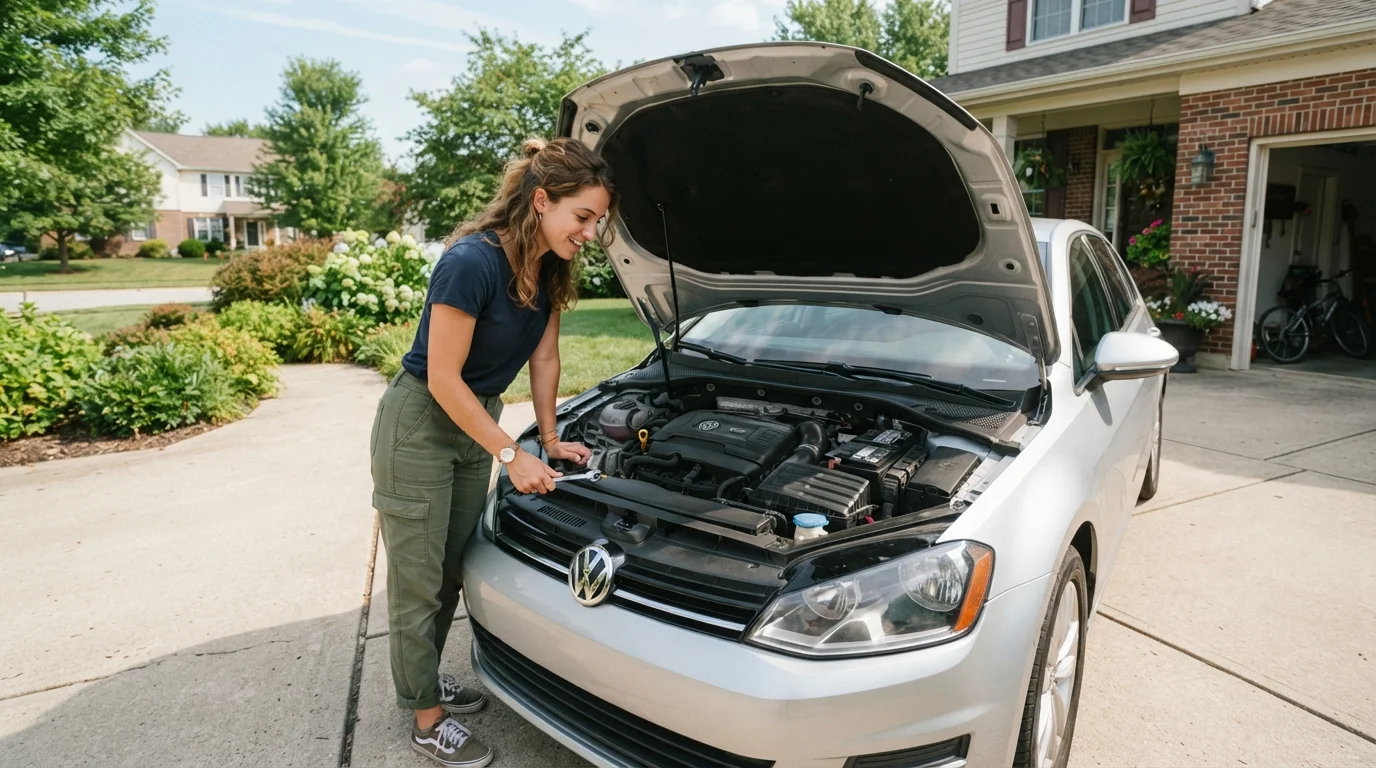
Your car depends on several fluids to operate safely. Running low on any of them — or ignoring contaminated fluid — can cause damage that far outweighs the cost of a quick top-up.
- Engine oil: Lubricates moving engine parts. Check the dipstick when the engine is cold. Oil should be between the min and max marks and appear a golden or light brown colour. Dark, gritty oil is a sign it's overdue for a change.
- Coolant (antifreeze): Keeps your engine from overheating or freezing. Check the reservoir level — never open the radiator cap when the engine is hot.
- Brake fluid: Transmits the force from your brake pedal to the brakes themselves. A low or discoloured level warrants prompt attention from a mechanic.
- Power steering fluid: If your car has hydraulic power steering, this fluid makes turning easier. Many newer vehicles use electric power steering and don't have this reservoir.
- Windshield washer fluid: The easiest to overlook and the easiest to fix. Running out at the wrong moment is more than inconvenient — it's a visibility hazard.
Your Owner's Manual Is Your Best Reference
Every vehicle has different fluid specifications, service intervals, and capacities. The owner's manual — usually in the glove box or available as a free PDF on the manufacturer's website — gives you the exact numbers for your car. Generic online advice is a starting point, but your manual has the final word.
Your owner's manual specifies the right fluid types and change intervals for your exact vehicle. Generic advice online may not match your car's requirements.
Tyres: Pressure, Tread, and Why Both Matter
Tyres are the only part of your car in contact with the road, which makes them one of the most important things to keep tabs on. Two checks cover most of what matters.
Tyre Pressure
Under-inflated tyres wear unevenly, reduce fuel efficiency, and handle poorly — especially in wet or emergency conditions. Over-inflated tyres offer less grip and are more vulnerable to damage from road hazards. Check pressure at least once a month using an inexpensive gauge. The correct pressure for your car is printed on a sticker inside the driver's door jamb, not on the tyre itself.
Tread Depth
Worn tread dramatically increases stopping distances, particularly on wet roads. The quarter test is a quick field check: insert a quarter into the tread groove with Washington's head pointing down. If you can see the top of his head, the tread is getting low and you should have the tyres inspected. For a more precise reading, a tread depth gauge costs just a few dollars.
Uneven tread wear can also reveal deeper problems. Tyre wear patterns can point to issues with alignment, inflation, or suspension — all worth catching early.
Never Judge Tyre Pressure by Eye
A tyre can be significantly under-inflated and still look fine to a casual glance. The only reliable way to check pressure is with a gauge. Modern cars with a tyre pressure monitoring system (TPMS) will alert you when a tyre drops well below the recommended level — but that alert means you're already low, not that you're in the ideal range.
Lights, Wipers, and the Checks You Can Do in Minutes
Some of the most important safety checks require no tools and take almost no time. Make it a habit to walk around your car periodically and check that all exterior lights are working — headlights, brake lights, turn signals, and reverse lights. A dead bulb can earn you a traffic citation, and more importantly, it makes you less visible to other drivers.
Wiper blades are another easy one to overlook until it's raining hard. If your wipers streak, skip, or chatter across the windshield, they're telling you they're due for replacement. Most blade changes take under five minutes with no tools required.
Before any longer drive, a quick visual walk-around is a useful habit. A pre-trip checklist can help you make this routine rather than something you only remember when something goes wrong.
A Walk-Around Takes Less Than Two Minutes
A quick visual check before driving doesn't need to be a formal inspection. Simply walking around the car while it warms up — glancing at tyre sidewalls, checking that lights come on, looking for anything that seems off — takes under two minutes and can catch problems before they become roadside emergencies.
When to See a Mechanic — and When Not to Wait
Part of good car ownership is knowing where your own competence ends. Checking fluids, testing lights, and inspecting tyre pressure are all reasonable DIY tasks for most drivers. Brake work, suspension repairs, timing belt replacement, and anything involving your vehicle's electrical system generally belong in a professional's hands. If you're unsure where the line is, our guide on DIY vs. mechanic tasks lays it out clearly.
Dashboard warning lights should be treated as communications, not annoyances. A check engine light, a battery warning, or a low oil pressure light all mean something specific. Ignoring them typically turns a manageable problem into a costly one.
Finally, keep a simple log of when you checked fluids, rotated tyres, and had the car serviced. It takes two minutes to update and makes it far easier to stay on schedule — and to demonstrate to a mechanic (or future buyer) that the car has been looked after. For a more thorough look at building lasting habits, see our overview of keeping a car running well for the long haul.
First-year ownership responsibilities can catch even attentive new drivers off guard — knowing them in advance puts you ahead of the curve.