

Key Takeaways
- Old engine oil loses its ability to lubricate and starts carrying abrasive particles throughout the engine.
- Each skipped service builds on previous damage, making repairs exponentially more expensive.
- Coolant, transmission fluid, and brake fluid degradation each cause their own chain of failures.
- Many engine problems from deferred maintenance are irreversible — prevention is far cheaper than repair.
- Manufacturers set service intervals based on engineering data, not sales incentives.
Deferred Maintenance
Deferred maintenance means delaying or skipping scheduled service tasks — like oil changes, fluid top-ups, or filter replacements — beyond the manufacturer's recommended intervals. While it may seem harmless in the short term, each missed service allows wear and contamination to accumulate inside the engine. The effects are rarely dramatic at first, but they compound quickly over time.
Engines rely on precise tolerances between moving metal parts. Degraded or insufficient lubrication increases friction at those contact points, accelerating wear in ways that can't always be reversed.
The First Domino: What Degraded Oil Actually Does
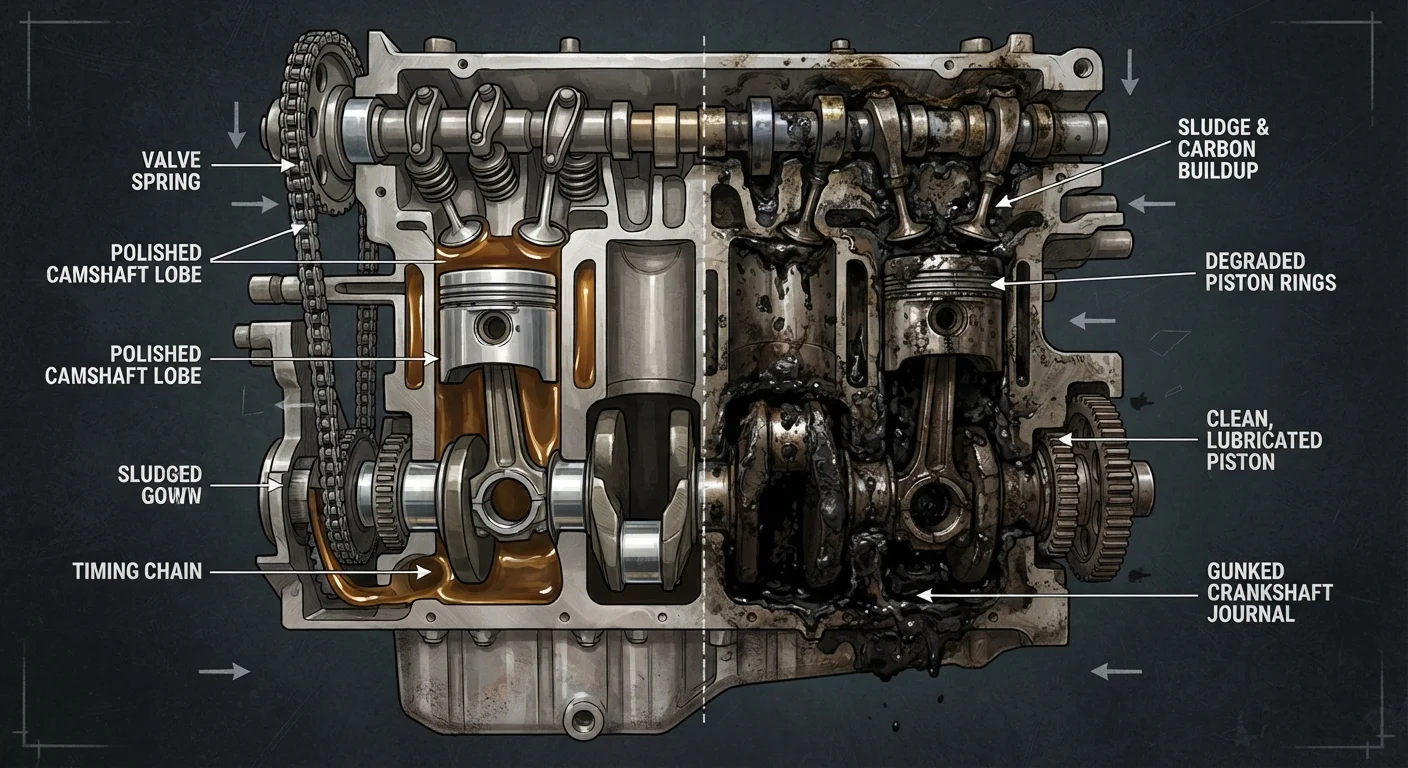
Fresh engine oil does several jobs at once — it lubricates metal surfaces, carries heat away from moving parts, suspends combustion byproducts, and contains additives that prevent corrosion. As oil ages, every one of those functions deteriorates.
The most immediate consequence is a loss of viscosity stability. Oil that has broken down becomes either too thin under heat or too thick when cold — neither protects metal surfaces the way fresh oil does. Simultaneously, the suspended contaminants — combustion residue, metal particles, and moisture — accumulate until the oil resembles a mild abrasive slurry rather than a lubricant.
That abrasive mix circulates through bearings, camshaft lobes, piston rings, and valve train components with every revolution of the engine. Metal wears against metal at tolerances measured in thousandths of an inch. Once those tolerances open up, the damage is structural and permanent.
Check Your Oil Between Services
Don't wait for your next scheduled oil change to pull the dipstick. A quick check every few weeks reveals oil level, color, and consistency. Oil that looks very dark or has a gritty texture is overdue for a change regardless of mileage. This two-minute habit can catch problems before they become expensive.
For a clear breakdown of what oil change intervals actually mean for your specific vehicle, see Oil Changes: What the Intervals Actually Mean.
How One Skipped Service Sets Up the Next Failure
Deferred maintenance rarely produces a single isolated problem. More often, one neglected system stresses adjacent systems until they fail in sequence.
Consider the relationship between the cooling system and the engine block. Coolant contains corrosion inhibitors that deplete over time. Once those inhibitors are exhausted, the coolant becomes acidic and begins attacking metal surfaces, rubber hoses, and the water pump impeller. A degraded water pump moves less coolant, causing the engine to run hotter. Elevated operating temperatures accelerate oil breakdown — so now two systems are failing simultaneously.
~$100
Typical cost of a full synthetic oil change
Compared to engine bearing replacement or rebuild costs that commonly run into thousands of dollars, routine oil changes represent a fraction of the financial risk.
5x–10x
Friction increase from oil film breakdown
Engineering studies on lubrication loss show metal-to-metal contact friction can rise dramatically once the oil film between bearing surfaces fails.
60%
Of engine wear occurs at cold startup
Industry estimates suggest the majority of engine wear happens in the first seconds after a cold start, when oil hasn't yet circulated — making oil condition especially critical.
A similar cascade happens with transmission fluid. Automatic transmissions rely on clean fluid to maintain hydraulic pressure in shifting circuits and to cool clutch packs. Old, oxidized fluid loses its ability to do either. The result is sluggish shifts, overheating clutch packs, and eventually transmission failure — a repair that can run well into four figures.
This compounding pattern is why understanding your full maintenance schedule matters, not just tracking oil change stickers.
The Internal Damage You Can't See or Hear (Until It's Too Late)
One of the most dangerous aspects of deferred maintenance is how quietly internal damage progresses. Piston rings that have worn past their service tolerance allow combustion gases to blow past them into the crankcase — a condition called blow-by. This pressurizes the crankcase, forces oil past seals, and dilutes remaining oil with fuel vapor. Fuel economy drops, oil consumption rises, and the engine produces less power, but none of this announces itself with a loud noise or a dashboard warning light until significant damage has occurred.
Sludge formation is another silent consequence. When oil is left in service too long — especially in engines that run frequent short trips — oxidation and moisture combine to create a thick, tar-like deposit that clings to oil passages and valve train components. Sludge restricts oil flow, starving parts of lubrication even when the oil level reads normal on the dipstick.
Manufacturer Intervals Are Minimum Standards
Service intervals in your owner's manual reflect the engineering team's tested thresholds for normal operating conditions. Severe-duty conditions — frequent towing, extreme temperatures, lots of short trips, dusty environments — typically warrant more frequent service. Check your manual for a 'severe duty' schedule if any of these apply to your driving.
Developing consistent habits around fluid checks and cold-start behavior can catch these problems before they escalate. Small consistent habits have a measurable impact on how long an engine stays reliable.
The Real Cost Calculation
Drivers sometimes defer maintenance to save money in the short term. The math rarely works in their favor. A typical oil change costs a fraction of what a single bearing replacement, head gasket repair, or transmission rebuild runs. Major engine repairs — particularly those caused by lubrication failure or chronic overheating — can easily exceed the market value of older vehicles.
Beyond direct repair costs, deferred maintenance affects resale value and reliability in ways that are difficult to recover from. Buyers and inspection mechanics can identify telltale signs: sludge in the valve cover, worn timing chain components, or a history of overheating recorded in diagnostic codes.
“An engine doesn't fail all at once. It's a slow accumulation of small deficiencies — each one tolerable on its own, but together they create a machine that's working against itself.”
— A veteran automotive engineer, Engine design and durability specialist, speaking generally on powertrain longevity
The habits that preserve an engine over the long term are straightforward. Consistent servicing and fluid management compound positively, just as neglect compounds negatively. The engine doesn't care about your schedule — it responds only to what's in it and how it's treated.
This article provides general automotive information for educational purposes. For guidance specific to your vehicle, consult your owner's manual or a qualified mechanic.