
Car Depreciation Explained: Why Your Vehicle Loses Value and What Affects the Rate

Key Takeaways
- New cars typically lose 15–25% of their value in the first year alone.
- Mileage, condition, and service history all directly affect how fast a car depreciates.
- Depreciation is often the single largest cost of car ownership over a five-year period.
- Keeping detailed maintenance records can help slow the rate of value loss.
- Understanding depreciation helps you make smarter decisions when buying, selling, or financing.
Car Depreciation
Car depreciation is the decline in a vehicle's market value over time. Every car loses value from the moment it's purchased, and that loss continues throughout the vehicle's life. Depreciation represents the difference between what you paid for a car and what you could sell it for later.
Depreciation is typically expressed as a percentage of original value lost per year. It is a non-cash cost — you don't write a check for it — but it is very real when you sell or trade in the vehicle.
How Depreciation Works
From the day you drive a new car off the lot, its value begins to fall. This isn't a flaw in the system — it reflects the real economics of the used-car market. A buyer purchasing a used vehicle takes on unknown wear history and loses the original manufacturer warranty protections that come with a new purchase, so they pay less.
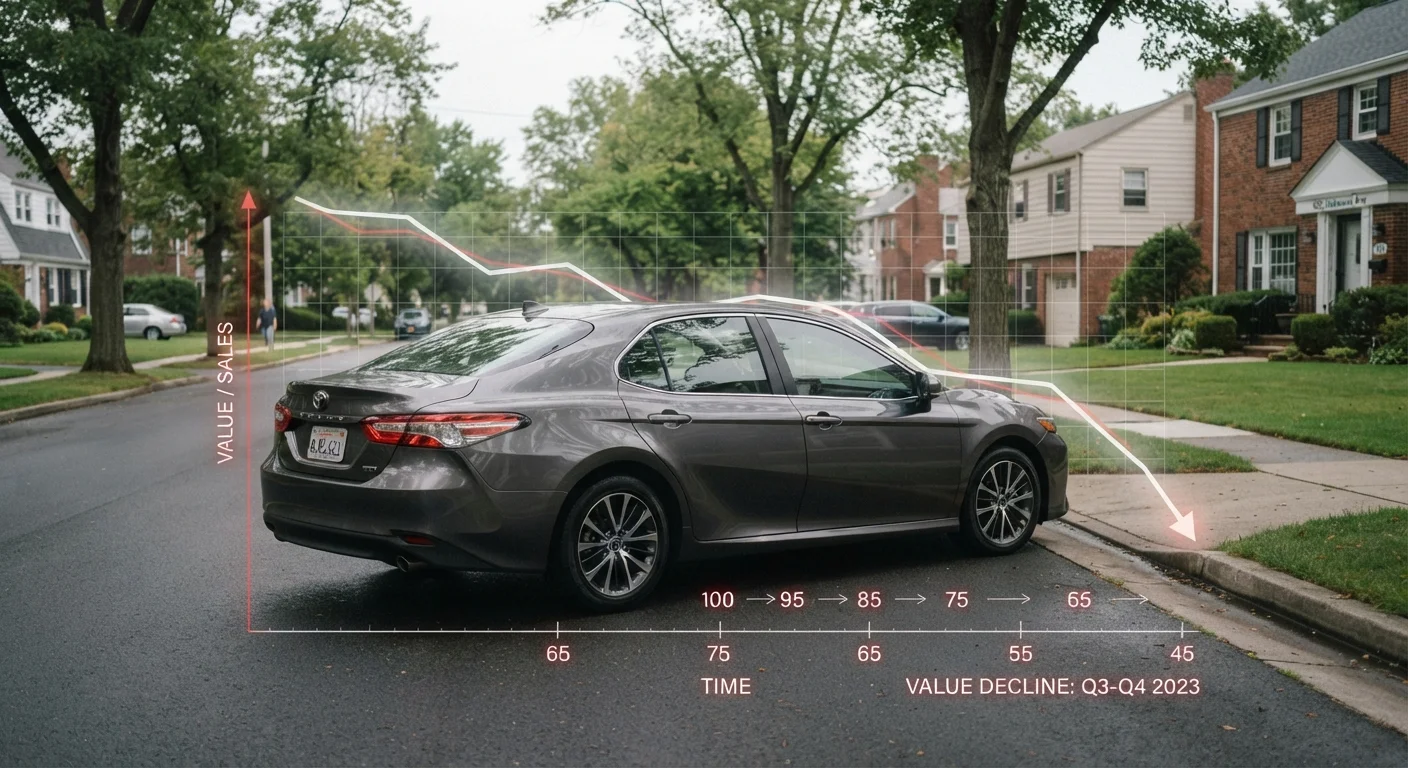
Depreciation isn't uniform. The sharpest drop happens early: the average new car loses a significant portion of its value within the first 12 months, and continues declining through year five before the rate typically flattens. A vehicle bought for $35,000 might be worth $20,000 or less after five years of average use — a loss that rarely gets the same attention as monthly loan payments, but which can easily dwarf them.
As part of the true cost of owning a car, depreciation deserves a front-row seat in your ownership planning.
~20%
Average value lost in year one
Industry estimates commonly place first-year depreciation for new vehicles between 15% and 25% of purchase price.
~50%
Value remaining after five years
Many new vehicles retain roughly half their original value after five years of average use, though this varies considerably by segment and model.
#1
Largest single ownership cost
For many drivers, depreciation exceeds fuel, insurance, and maintenance costs combined over a typical five-year ownership period.
Key Factors That Accelerate or Slow Value Loss
Depreciation isn't entirely out of your control. Several factors influence how quickly a specific vehicle loses value:
- Mileage: More miles mean more wear. Exceeding average annual mileage benchmarks (typically around 12,000–15,000 miles per year) tends to push resale value down faster.
- Condition: Dents, scratched paint, worn interiors, and neglected mechanicals all reduce what a buyer will pay. Cosmetic damage is surprisingly costly to resale value.
- Maintenance history: A vehicle with documented, on-schedule servicing signals lower risk to a buyer. Missing or incomplete records raise doubt and lower offers. See our guide on keeping a car running well for the long haul for practical maintenance habits.
- Vehicle type and segment: Some categories — like large luxury sedans — have historically depreciated faster than trucks or compact SUVs, partly because of market demand patterns.
- Market conditions: Used-car supply and demand affect resale values broadly. Periods of low used-car inventory can slow depreciation; oversupply accelerates it.
Document Every Service Visit
Keep receipts and records from every oil change, tire rotation, and scheduled service — even routine ones. When it's time to sell, a complete paper trail reassures buyers and supports a higher asking price. A simple folder in the glove box or a phone photo album works fine.
Why It Matters for Ownership Decisions
Understanding depreciation changes how you look at several common ownership decisions.
Buying new vs. used: Purchasing a vehicle that is two to three years old lets a previous owner absorb the steepest part of the depreciation curve. You may get a vehicle with significant remaining useful life at a meaningfully lower price per mile of use.
How long you keep the car: The longer you keep a vehicle past the steep early-depreciation years, the more you spread that initial loss across more miles driven — effectively lowering the per-mile cost of ownership. This is one reason high-mileage drivers often find long-term ownership more economical.
Financing decisions: Depreciation interacts directly with auto loans. If you finance a vehicle and it depreciates faster than you pay down the loan balance, you may end up "underwater" — owing more than the car is worth. Gap insurance (a product that covers this difference if the car is totaled) exists specifically because of this risk. For a broader look at financing trade-offs, see our car financing comparison.
“Depreciation is the cost most car buyers ignore because they never write a check for it — but it's often the biggest check they'll never see.”
— Cars & Driving Editorial Team, Automotive ownership and cost analysis
Practical Steps to Protect Resale Value
You won't stop depreciation, but you can manage its pace. A few consistent habits make a real difference when it's time to sell or trade in:
- Keep up with scheduled maintenance and hold on to every service record.
- Address cosmetic damage promptly — small dents and scratches compound in a buyer's mind.
- Avoid modifications that appeal to a narrow audience; they can shrink your buyer pool.
- Keep interior and exterior clean; a well-kept appearance suggests a well-kept car overall.
- Be mindful of mileage if resale within a few years is your plan.
Depreciation is one piece of a larger ownership cost picture. For a complete view of what a vehicle actually costs over time, our article on the true cost of car ownership beyond the sticker price walks through fuel, insurance, maintenance, and more in one place.
Depreciation Varies Widely by Segment
Trucks and SUVs have historically held value better than large sedans in the US market, largely because of sustained consumer demand. Luxury and sports vehicles can depreciate quickly once they leave the new-car halo. These are general patterns, not guarantees — individual model performance varies, and market conditions shift over time.