

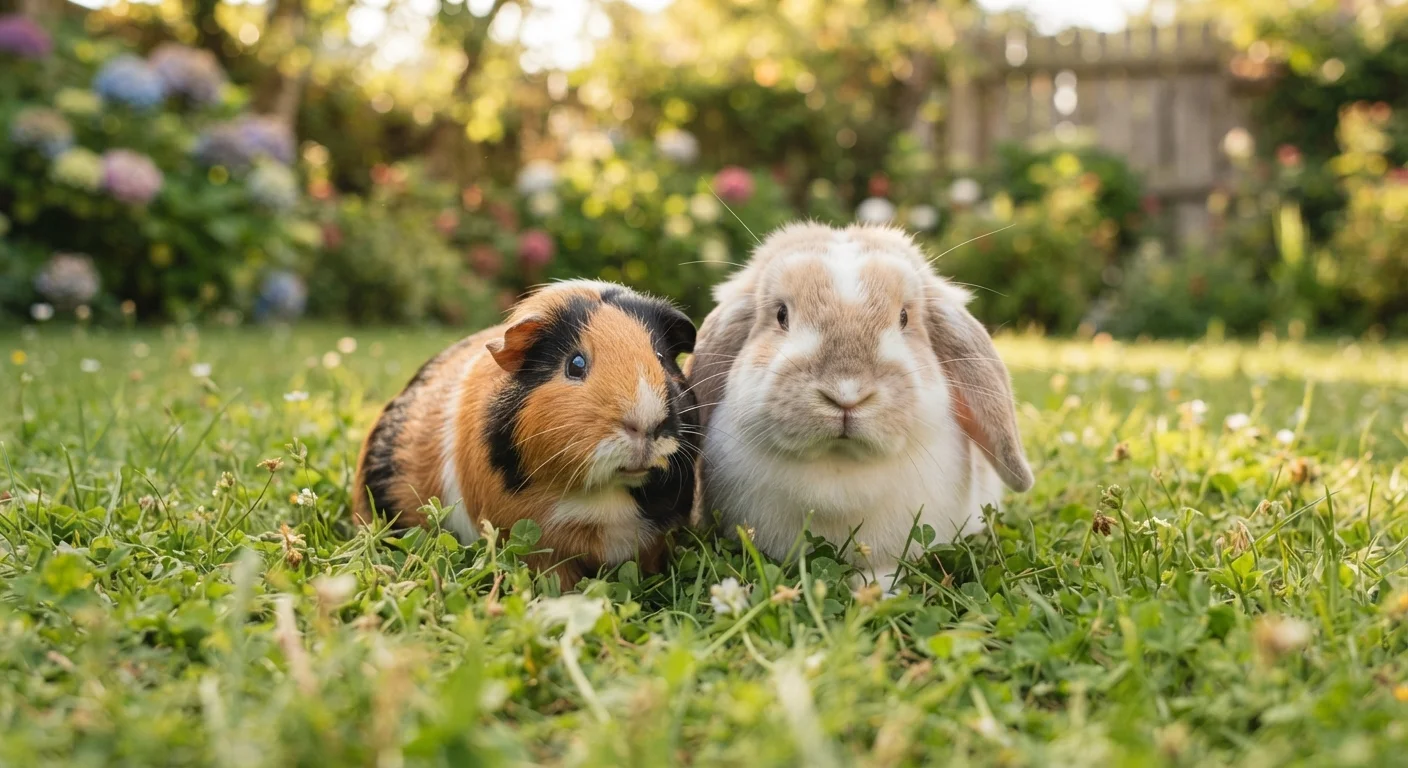
Key Takeaways
- Guinea pigs are highly social and do best when kept in same-sex pairs or small groups.
- Rabbits need significantly more space and daily free-roaming exercise than guinea pigs.
- Rabbits typically live 8–12 years; guinea pigs usually live 4–7 years — a meaningful commitment difference.
- Both species hide illness well, so routine veterinary check-ups are essential for early detection.
- Guinea pigs are generally more tolerant of handling; rabbits can be easily injured if held incorrectly.
- Neither species is a low-effort pet — both require daily interaction, fresh food, and appropriate housing.
Option A
Guinea Pigs
The sociable, low-maintenance companion for families and first-time owners.
Best for: Households seeking a gentle, vocal, easy-to-handle small pet that thrives in pairs.
Option B
Rabbits
The active, independent pet that rewards patient, experienced owners.
Best for: Owners who can provide ample space, daily exercise time, and a calm, rabbit-proofed environment.
If you want a first small pet for a family with children
Guinea Pigs
Guinea pigs are sturdier when handled gently, vocalize their needs clearly, and are less likely to kick or scratch when startled — making them more forgiving for young handlers.
If you have plenty of space and enjoy an interactive, curious pet
Rabbits
Rabbits form strong bonds with patient owners and display entertaining personalities, but they need room to run and a fully rabbit-proofed environment to stay safe.
If your living situation means a shorter-term commitment
Guinea Pigs
With a typical lifespan of 4–7 years, guinea pigs represent a shorter commitment than rabbits, who commonly live 8–12 years with proper care.
If you want a pet that can be litter-trained and given free-roam time
Rabbits
Rabbits can be reliably litter-trained and, once a space is rabbit-proofed, can live much like a small house pet with supervised or free-roam access to rooms.
If you are concerned about veterinary costs and complexity
Guinea Pigs
Guinea pigs generally have simpler care requirements; rabbits are prone to dental disease and gastrointestinal stasis, conditions that can require urgent and costly veterinary intervention.
Social Needs and Companionship
One of the biggest differences between these two species is how they experience companionship. Guinea pigs are obligate social animals — they communicate through a rich repertoire of sounds (purring, wheeking, rumbling) and become visibly stressed when housed alone. Most animal welfare organisations recommend keeping guinea pigs in groups of at least two. For a deeper look at what drives these social dynamics, see the social lives of small pets.
Rabbits are more nuanced. In the wild they live in warrens, but domesticated rabbits can be territorial, and bonding two rabbits requires a careful, gradual introduction process. A bonded pair typically provides mutual grooming and companionship — but a poorly matched pair can injure each other seriously. A single rabbit that receives substantial daily human interaction can also thrive, provided it has enough stimulation and space.
Can Guinea Pigs and Rabbits Live Together?
Housing guinea pigs and rabbits together is not recommended by most veterinary and welfare organisations. Rabbits can unintentionally injure guinea pigs with powerful kicks, and rabbits may carry Bordetella bacteria that can cause serious respiratory illness in guinea pigs without affecting the rabbit itself. Each species is best housed with companions of their own kind.
Space, Housing, and Exercise
Rabbits need considerably more room than many people anticipate. A minimum enclosure for one rabbit should allow the animal to take at least three full hops and stand fully upright on its hind legs. Beyond the enclosure, rabbits require several hours of free-roaming exercise each day in a rabbit-proofed area — they chew wiring, baseboards, and houseplants with enthusiasm. Our guide on setting up a rabbit's living space covers enclosure sizing and essential safety considerations in detail.
Guinea pigs also need generous floor space — a common recommendation is a minimum of 7.5 square feet for two animals — but they do not require the same level of free-roaming access. They are ground-dwelling animals and do not jump or climb, which simplifies housing design. Multi-level enclosures common in small-pet retail can actually be risky for guinea pigs, as falls cause injury. Whether you plan to keep either species indoors or outdoors also matters significantly; indoor vs. outdoor housing for rabbits and guinea pigs explores those trade-offs thoroughly.
| Criterion | Guinea Pigs | Rabbits |
|---|---|---|
| Typical lifespan | 4–7 years | 8–12 years |
| Minimum housing space (pair) | ~7.5 sq ft floor space | Larger enclosure + daily free roam |
| Social requirement | Strongly prefer pairs/groups | Pair or solo with human bonding |
| Handling ease | Generally tolerant | Requires careful technique |
| Litter training | Partial / inconsistent | Can be reliably trained |
| Key dietary requirement | Daily vitamin C source | Unlimited grass hay (80%+ of diet) |
| Common health risk | Scurvy, respiratory illness | GI stasis, dental disease |
| Noise level | Vocal (wheeking, purring) | Mostly quiet |
Handling, Temperament, and Lifespan
Guinea pigs have a reputation for tolerating gentle handling relatively well, though they are prey animals and will startle. Their compact, low-to-the-ground body makes them easier to hold safely, and they rarely bite unless they feel cornered or are in pain. Children can learn to handle them with adult supervision and a little practice.
Rabbits require more careful handling. Their powerful hind legs can kick hard enough to fracture their own spine if they feel unsupported and panicked — an injury that is unfortunately not uncommon. Picking up a rabbit correctly takes practice, and some rabbits simply prefer to interact at ground level rather than being lifted. Many rabbit owners find their pets are most affectionate when approached on the rabbit's own terms.
Lifespan is a factor worth weighing carefully. Guinea pigs typically live 4–7 years; well-cared-for rabbits commonly reach 8–12 years. That is a meaningful difference in long-term commitment, including veterinary costs over time.
4–7 yrs
Average guinea pig lifespan
General veterinary consensus places the typical domestic guinea pig lifespan between 4 and 7 years with proper care.
8–12 yrs
Average domestic rabbit lifespan
House rabbits kept indoors with appropriate diet and veterinary care commonly live 8 to 12 years, per rabbit welfare organisations.
80%+
Hay in a rabbit's daily diet
Rabbit welfare experts consistently recommend that grass hay make up the vast majority of a rabbit's daily food intake to support dental and gut health.
Health Considerations and Veterinary Care
Both species are prey animals that instinctively conceal signs of illness — by the time symptoms are obvious, a condition may already be serious. Routine check-ups with an exotic animal veterinarian (not all general-practice vets are experienced with rabbits or guinea pigs) are strongly recommended for both. For a practical overview of what to watch for, why small pets get sick quietly outlines the subtle warning signs owners should know.
Guinea pigs cannot synthesize vitamin C and must receive it daily through fresh vegetables or supplements — deficiency causes scurvy, a preventable but serious condition. Rabbits are particularly vulnerable to gastrointestinal stasis (a slowdown or stoppage of gut movement) and dental disease rooted in insufficient hay consumption. Both conditions can become life-threatening quickly and may require emergency veterinary care.
This article is for general informational purposes only and is not a substitute for advice from a qualified veterinarian familiar with your specific animal.