

Key Takeaways
- Rabbits need far more space than small cages provide — a minimum enclosure of 12 square feet is a common starting point.
- Wire-bottom cages hurt rabbit feet; solid flooring with appropriate bedding is essential.
- Hay should make up roughly 80% of a rabbit's diet and must always be available.
- Hiding spots are not optional — they are a core welfare need for prey animals like rabbits.
- Daily supervised free-roaming time outside the enclosure supports physical and mental health.
- Cables, toxic plants, and certain flooring materials pose serious hazards to free-roaming rabbits.
Start here
How Much Space Does a Rabbit Really Need?
Next
Flooring, Bedding, and Comfort Basics
Then
Essential Furnishings: Food, Water, and Hiding Spots
Almost ready
Rabbit-Proofing Your Home for Safe Free Roaming
Final step
Placement and Environment: Getting the Location Right
How Much Space Does a Rabbit Really Need?
One of the most common mistakes first-time rabbit owners make is underestimating how much space their pet actually requires. Pet shop displays often feature small cages, but these rarely meet a rabbit's welfare needs. A widely cited guideline from rabbit welfare organizations is a minimum of 12 square feet of enclosure space, combined with access to a larger daily exercise area of at least 32 square feet.
Inside the enclosure, your rabbit should be able to take three to four full consecutive hops and stand fully upright on its hind legs without touching the roof. If the setup feels cramped to you, it almost certainly is for the rabbit.
Many owners find that modular pen systems — open-top wire panels arranged into a large connected space — work better than traditional hutches. These can be expanded as needed and allow easy cleaning access. If you are still weighing whether a rabbit is the right pet for your household, our comparison of rabbits and guinea pigs as companion animals may help clarify what fits your home.
Sore hocks
A painful skin condition affecting the bottom of a rabbit's feet, often caused by prolonged contact with wire flooring or wet, soiled bedding.
Timothy hay
A type of grass hay that forms the dietary foundation for adult rabbits, providing the fiber they need for healthy digestion.
Prey animal
An animal that is naturally hunted by predators in the wild. Rabbits are prey animals, which means they are instinctively alert to threats and need hiding spaces to feel safe.
Enclosure
The primary living space where a rabbit spends time when not free-roaming — this could be a pen, hutch, or modular setup.
Free roaming
Allowing a rabbit to move freely outside its enclosure in a safe, supervised space for exercise and mental enrichment.
Flooring, Bedding, and Comfort Basics
Wire-bottom cages — once common in hutch designs — are now widely discouraged by veterinary and welfare groups. Rabbit feet have no protective paw pads, making wire surfaces painful and a risk factor for a condition called sore hocks (ulcerated skin on the bottom of the feet). Solid flooring is the standard to aim for.
Cover the floor of the enclosure with a safe bedding material. Paper-based bedding is a popular choice because it is absorbent and low-dust. A deep layer of timothy hay in the resting area also doubles as both bedding and food. Avoid cedar and pine shavings, which contain aromatic compounds that can irritate a rabbit's airways.
Spot-clean the enclosure daily and do a full bedding change at least once a week. Rabbits are naturally clean animals and will often choose a specific corner to use as a litter area — placing a litter box there makes cleanup much simpler.
Use the Litter Box to Your Advantage
Rabbits naturally choose one spot in their enclosure to toilet. Place a litter box filled with paper-based litter and a layer of hay in that preferred corner. Most rabbits will use it consistently, making daily cleaning quick and straightforward. Hay in the litter box also encourages healthy eating habits, since rabbits often graze and toilet simultaneously.
Essential Furnishings: Food, Water, and Hiding Spots
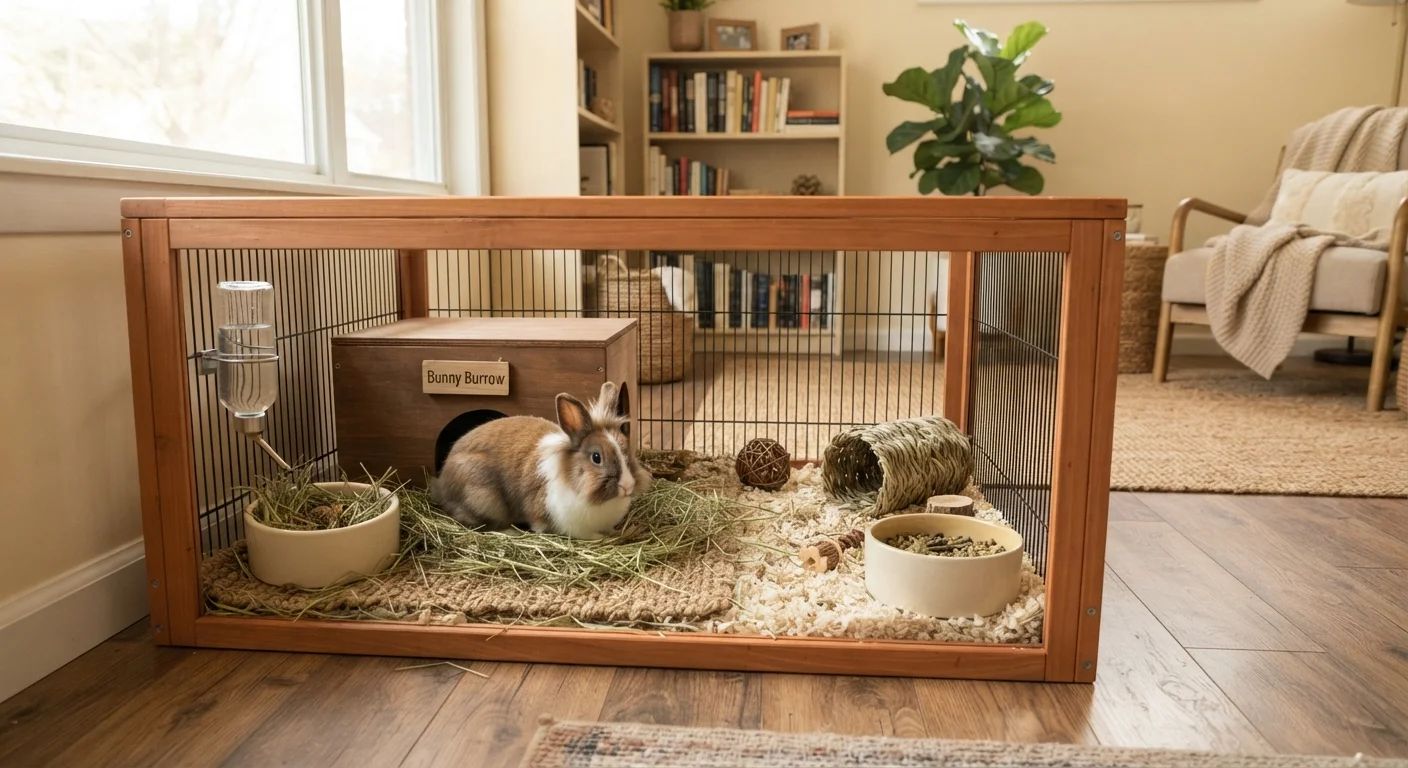
Every rabbit enclosure needs three core furnishings: a hay rack, a water source, and a hiding spot.
- Hay rack: Hay should make up roughly 80% of a rabbit's diet and must be available at all times. A mounted rack keeps hay clean and dry better than placing it loose on the floor.
- Water: Both bottles and heavy ceramic bowls work. Bowls are often easier for rabbits to drink from naturally, but tip-proof designs help prevent spills and wet bedding.
- Hide box: As prey animals, rabbits are wired to seek enclosed, sheltered spaces when stressed or tired. A wooden hide box, cardboard tunnel, or fabric tent placed inside the enclosure is not a luxury — it is a genuine welfare need.
You can also add a few safe enrichment items: untreated wooden chew toys, cardboard boxes with holes cut in them, and tunnels all encourage natural digging and gnawing behavior. Keep the space from becoming too cluttered, though — rabbits need clear room to move.
House Rabbit Society
A nonprofit organization offering in-depth, veterinary-reviewed guidance on indoor rabbit care, diet, housing, and health — a reliable reference for new rabbit owners.
Rabbit Welfare Association & Fund (RWAF)
UK-based welfare organization with detailed, research-informed resources on rabbit housing standards, enrichment, and companionship needs — applicable to owners worldwide.
Rabbit-Proofing Your Home for Safe Free Roaming
Rabbits need several hours of free-roaming time outside their enclosure every day. Before you allow this, the space needs to be made safe. Rabbits are natural chewers and will investigate anything at floor level.
- Cables and cords: Cover or route all electrical cables through cable management sleeves or behind furniture. A chewed live wire is a life-threatening hazard.
- Toxic plants: Many common houseplants — including lilies, pothos, and aloe vera — are toxic to rabbits. Remove plants from the roaming zone or place them well out of reach.
- Flooring: Smooth surfaces like hardwood and tile can cause rabbits to slip and injure their limbs. Place non-slip rugs or mats along routes your rabbit is likely to use.
- Small gaps: Rabbits can squeeze behind appliances and under furniture. Block off spaces where your rabbit could become trapped or access wiring.
For a full pre-arrival safety checklist, see our guide on what to prepare before bringing a small pet home.
Never Leave a Free-Roaming Rabbit Unsupervised
Even a well-rabbit-proofed room can present unexpected hazards — an open door, a forgotten cable, or a visiting pet. Always supervise your rabbit during free-roaming time, especially in the first weeks as you learn your rabbit's habits and tendencies. Rabbits can move quickly and get into trouble faster than most owners expect.
Placement and Environment: Getting the Location Right
Where you place your rabbit's enclosure matters as much as what goes inside it. Rabbits are sensitive to temperature extremes — they do not tolerate heat well and can suffer from heatstroke at temperatures above roughly 80°F (27°C). Keep the enclosure away from direct sunlight, radiators, and drafty windows or doors.
Choose a quieter area of the home, away from televisions or speakers played at high volume and heavy foot traffic. At the same time, rabbits are social animals that benefit from being part of household activity, so total isolation in a back room is not ideal either. A corner of a living room or a calm bedroom tends to strike a good balance.
If you want a broader look at how to structure your rabbit's habitat beyond the basics, our article on setting up a rabbit's living space that actually works explores flooring choices, indoor versus outdoor setups, and more.
This article provides general information about rabbit care and is not a substitute for advice from a qualified veterinarian. If you have questions about your rabbit's health or specific needs, please consult a rabbit-savvy vet.